





AwardWallet receives compensation from advertising partners for links on the blog. The opinions expressed here are our own and have not been reviewed, provided, or approved by any bank advertiser. Here's our complete list of Advertisers.
One of the best ways to redeem points and miles is to book international business class award tickets. Unfortunately, awards in some of the most premium cabins come at…well, a premium. But you can also access business and first class by purchasing a cash fare and upgrading with miles. And sometimes, it can make a lot of sense.
Here's a look at how you can upgrade your ticket with points and miles, and when you should consider doing so.
Ways To Upgrade Your Paid Airline Ticket
While every air carrier has different policies regarding upgrades, there are three primary ways to upgrade your economy or premium economy seat to a business- or first-class one:
- Earn elite status: Most carriers offer space-available complimentary upgrades to elite members. Many airlines also offer elite members upgrade certificates — such as
American Airlines - Pay cash to upgrade: Assuming there is space available, you will often see an option to upgrade your seat in your account before departure. You can also request an upgrade at the check-in counter for a fee. Select carriers even let you bid for upgrades.
- Redeem points and miles to upgrade: You can upgrade using your airline miles if you've purchased a paid ticket in an eligible fare class.
In this post, we're taking a detailed look at the third option: upgrading with miles. Before we get into the details, remember that each airline has unique rules about how to upgrade with miles, when you can upgrade, and what it costs. If you intend to upgrade with miles, ensure you understand each program's rules before you pull out your favorite travel
Airlines That Use Dynamic Pricing for Award Upgrades
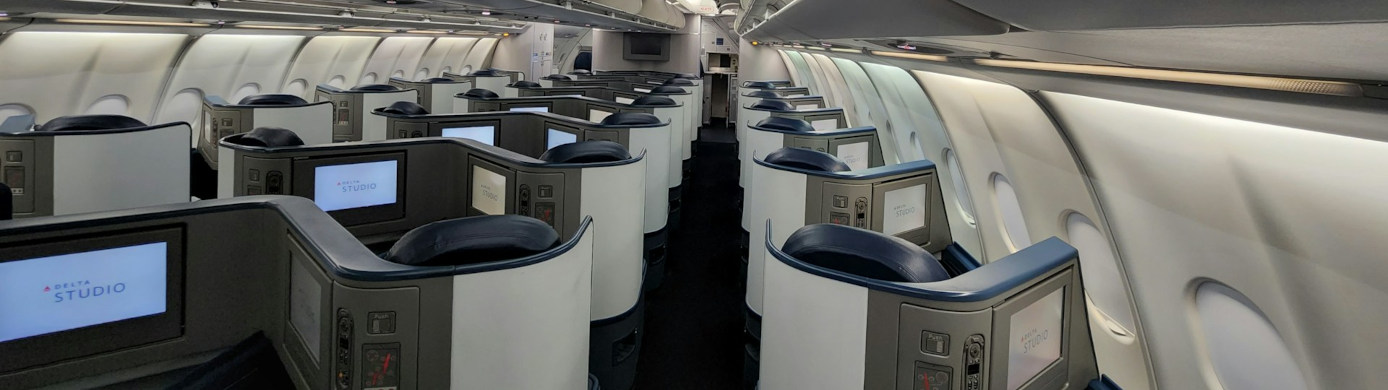
Most U.S. airlines, along with some popular international airlines, allow you to use miles to upgrade your flight, but the upgrade awards are dynamically priced. After you book your flight, you might see an offer in your account to upgrade to business class using cash or miles. However, the price is based on availability and may not be a good value. Most airlines restrict upgrades (paid or using miles) if you've booked a basic economy ticket.
Airlines that use dynamic pricing for award upgrades include United, Delta, Air France, and Air Canada. However, each has its own rules and restrictions. For instance, if you booked an award ticket to begin with, you can't use miles to upgrade when flying with American or United.
You could use miles to upgrade when flying these airlines if you paid cash for your ticket. However, Delta allows you to use miles to upgrade, regardless of whether you used miles or cash to book your ticket. Meanwhile, Alaska Airlines doesn't allow you to use Atmos Rewards points to upgrade a ticket at all.
For these airlines, you'll have to do the math to determine whether the cents-per-mile value of an upgrade makes sense before accepting. Today, we're focusing coverage on airlines that publish an award chart or provide a public calculator to determine upgrade costs.
A Look at a Few Airlines That Offer Mileage Upgrades
Here's a look at three airlines that offer opportunities to upgrade with miles, along with examples of when upgrades may or may not make sense. To give you the most information, we selected airlines from two major alliances and one airline that isn't part of any alliance.
Singapore Airlines upgrade with miles
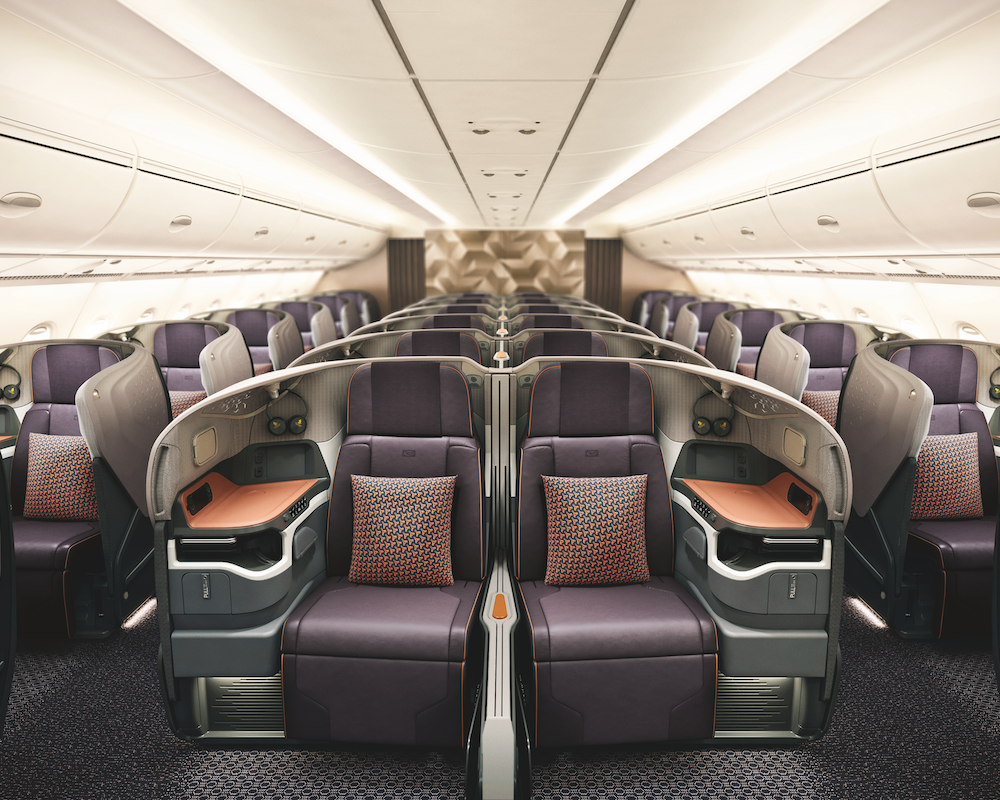
There are many reasons to rave about Singapore Airlines' premium cabins. The carrier offers a stellar premium economy and business class product, and you can easily redeem KrisFlyer miles to upgrade to better classes of service. And the upgrade prices (caution: PDF link) are compelling — especially on the carrier's fifth-freedom routes.
You can access business or first class on Singapore's route from New York (JFK) to Frankfurt (FRA) in one of several ways:
- Book a standard economy ticket in fare classes M, H, or W, then upgrade to business for 67,000 KrisFlyer miles.
- Book a premium economy ticket in fare classes P or L and upgrade to business for 37,500 miles.
- Book a business class ticket in fare classes Z, C, J, or U and upgrade to suites/first for 52,500 miles.
- Book a business class award outright for 89,000 miles.
- Book a first-class award outright for 106,500 miles.
Remember, this is the cost of the upgrade. You'll have to factor in how much you spent on the paid portion of your ticket to determine the real cost. For instance, let's say you were flying on a Monday in September during the off-season. You might see the following prices for the flight from New York to Frankfurt:
- Economy standard: $578
- Premium economy standard: $1,144
- Business standard: $2,717
- Suites/first: $11,512
In this scenario, it could make sense to upgrade from economy to business — you'd spend $578 on the original ticket, plus the value of redeeming 67,000 KrisFlyer miles (~$1,662 based on an average redemption value of 2.57¢ apiece), and still come out ahead of buying a business standard ticket outright by around $500.
However, during peak travel season, the cost of your cash portion could skyrocket. If you want to upgrade your ticket using miles, start by finding a cheap cash ticket. Also, be sure to factor in the cost of simply redeeming miles for your entire desired award if there is availability.
Assuming the above valuation for KrisFlyer miles, here's how much you could expect to “spend” on a business or first class saver award ticket for this route:
- Book a business class award outright: $2,207
- Book a first class award outright: $2,641
If you can find a business or first saver award, it could make sense to book that instead. And keep in mind, this will vary substantially based on your route. For example, an upgrade from economy to business on a flight from New York to Singapore would cost a whopping 103,000 KrisFlyer miles, while a business saver award would be just 117,000 miles. That's not a huge difference in miles, so it might be worth waiting for Saver award availability to open.
Emirates upgrade with miles
Emirates also offers plenty to rave about, courtesy of its incredible business and first-class cabins. And like most premium products, booking yourself into one of the carrier's posh seats requires a massive outlay of cash or miles — or maybe both for Emirates First Class.
Unfortunately, Emirates has inplemented a lot of devaluations over the past couple of years. Most transferable point currencies have either devalued transfers to Emirates or removed Emirates as a partner entirely. That means it's much more challenging to earn Skywards miles than ever before.
However, if you have some Skywards miles lying around, you can upgrade to Emirates first class at a reasonable cost.
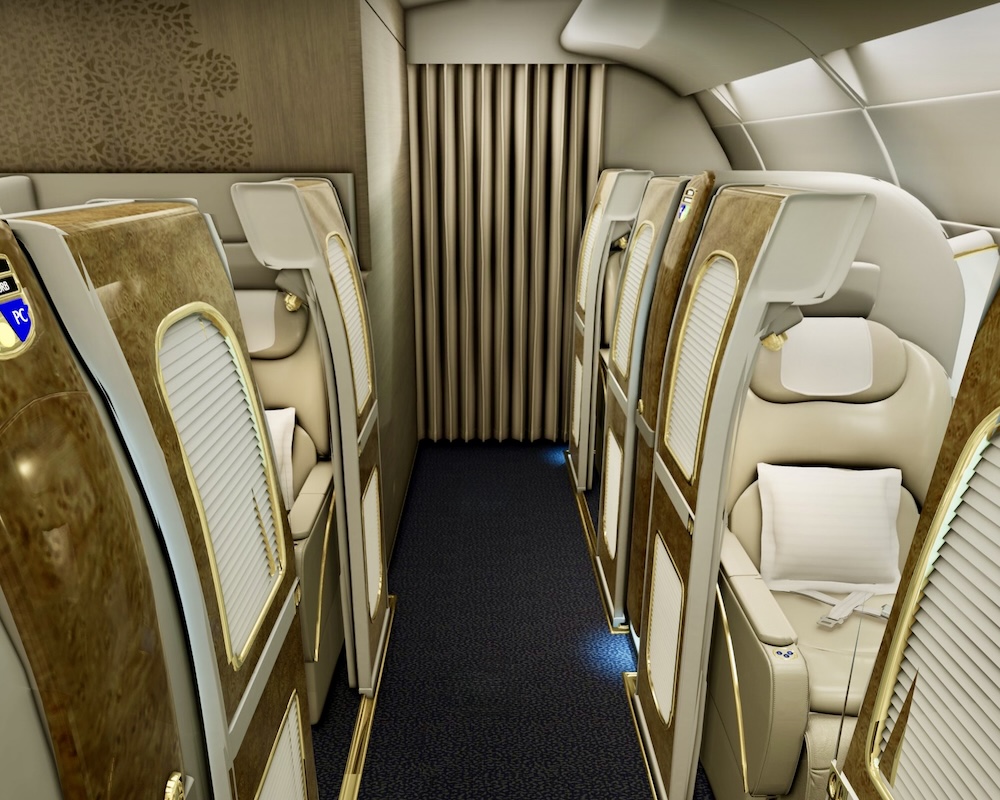
As an example, we'll take a look at upgrading to business class on Emirates' fifth-freedom route between Newark (EWR) and Athens (ATH). And as the story goes, some upgrades make more sense than others. You can access business class in one of two ways.
The first is booking an economy award. According to Emirates' calculator, here's how much you'll spend:
- Economy Saver: 17,500 miles, plus $123 in taxes and fees
- Economy Flex Plus: 30,000 miles, plus $123 in taxes and fees
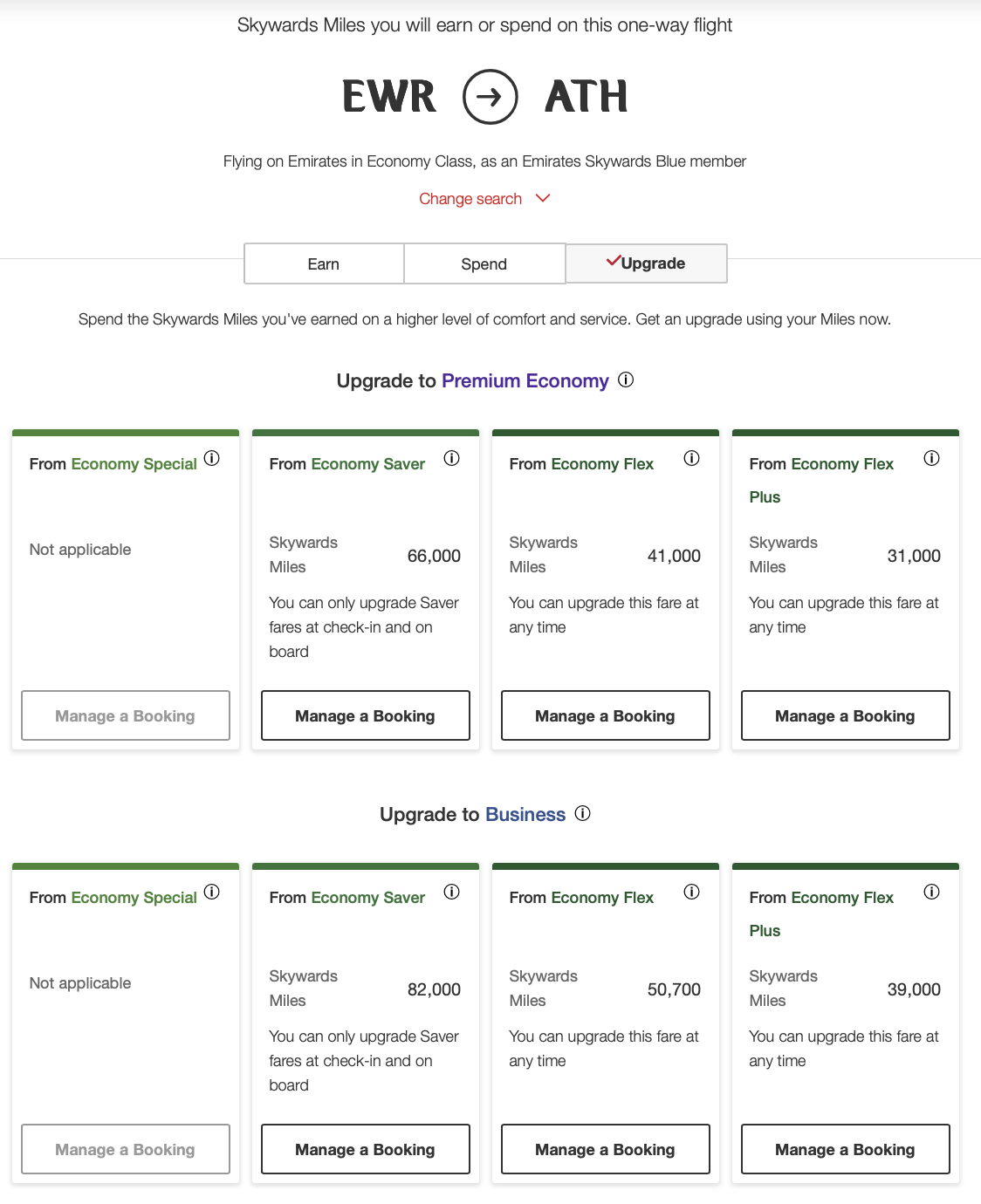
The cost of the upgrade will depend on which fare class you booked:
- Economy Saver to Business: 82,000 miles
- Economy Flex to Business: 57,500 miles
- Economy Flex Plus to Business: 39,000 miles
Note that you can only upgrade a Saver fare at check-in or on board, so there may not be any availability. Plus, if you're doing the math, booking an Economy Saver award and upgrading to business would cost a total of 99,500 Skywards miles. Booking an Economy Flex Plus award and upgrading to business would cost just 69,000 miles.
The second way is more straightforward. Simply book a business-class award outright for 87,000 Skywards miles, plus $434 in taxes and fees. While the award prices have stayed the same on this route over the past few years (or even decreased), taxes and fees have doubled or tripled, so be sure to factor them in to your calculations.
So, which option makes more sense? Let's check the math.
On average, AwardWallet users redeem Emirates Skywards miles for 1.55¢ apiece. So, you'd pay ~$605 in miles to upgrade from economy to business. This is on top of how much you spent in cash or miles to book the economy flex plus fare. Or, you could spend ~$1,349 worth of Skywards miles to book a business class award outright. As the numbers show, it's worth upgrading Emirates Flex Plus economy awards to business class. You'll redeem fewer miles and pay less out of pocket.
How does the math shake down on one of Emirates' longer routes, like Los Angeles (LAX) to Dubai (DXB)? You'll spend 57,500 Skywards miles to book an Economy Flex Plus fare, and 81,900 miles to upgrade to business. Or, you'll spend 157,500 miles to book a business ticket in the first place. And to make your way to first class, you'd spend another 81,900 miles.
On this route, too, it would be cheaper to book an economy ticket and upgrade it to business. However, if your goal is first class, you'd need to book a business class fare and then upgrade, as you can't upgrade from economy to first.
Qatar Airways upgrade with miles
As with other airlines, there are plenty of reasons to consider an upgrade when flying with Qatar Airways. Qatar Qsuites are still among the best business class products in the sky. Luckily, if you plan ahead, it's fairly easy to find yourself at this end of the plane.
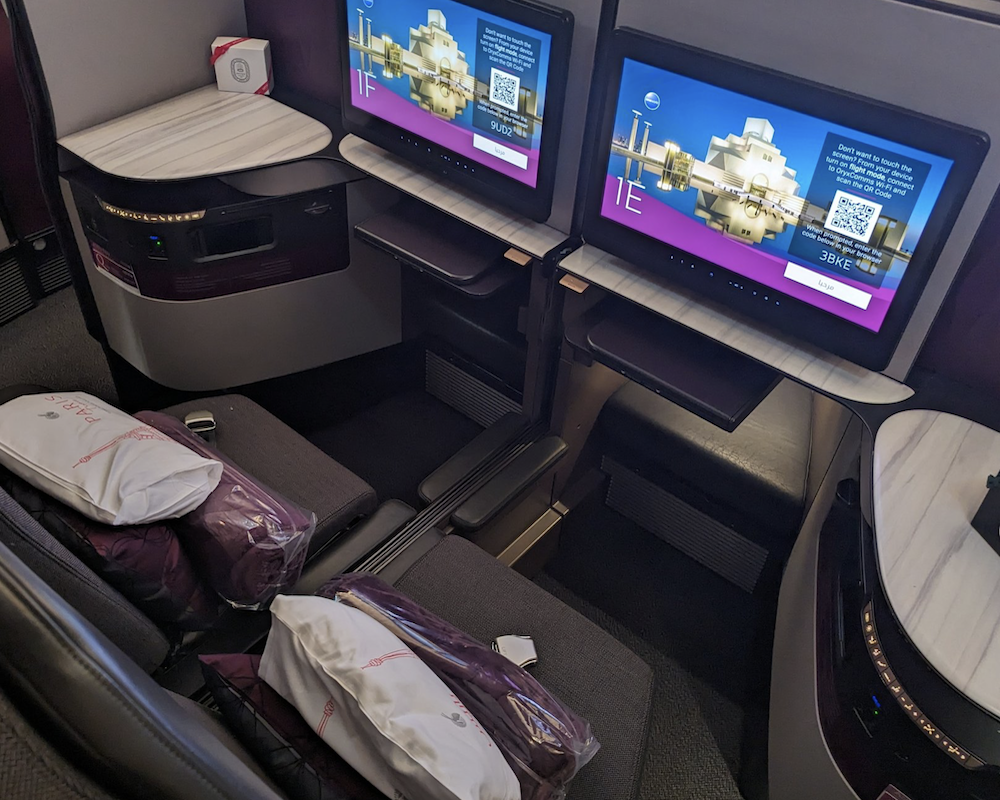
Just like Emirates, Qatar offers a handy calculator to know how much it will cost to book an award ticket or upgrade a paid fare. However, Qatar offers more upgrade options than either Singapore or Emirates.
Here's how you can access business class on a flight from New York (JFK) to Mumbai (BOM) with a layover in Doha (DOH):
- Book an economy ticket in fare classes K, L, M, S, or V, then upgrade to business for 71,500 Avios.
- Book an economy ticket in fare classes N, O, Q, or T, then upgrade to business for 95,500 Avios.
- Book an economy ticket in fare classes B, H, or Y, then upgrade to business for 48,000 Avios.
- Book a business class award outright for 80,000 Avios.
Although Qatar doesn't currently fly first class on routes to the U.S., here's the theorectical pricing for first class on this route:
- Book an economy ticket in fare classes B, H, or Y, then upgrade to first for 96,000 Avios.
- Book an economy ticket in fare classes K, L, M, S, or V, then upgrade to first for 143,000 Avios.
- Book an economy ticket in fare classes N, O, Q, or T, then upgrade to first for 191,000 Avios.
- Book a business ticket in fare classes C, D, I, J, or R, then upgrade to first for 71,500 Avios.
- Book a first class award outright for 120,000 Avios.
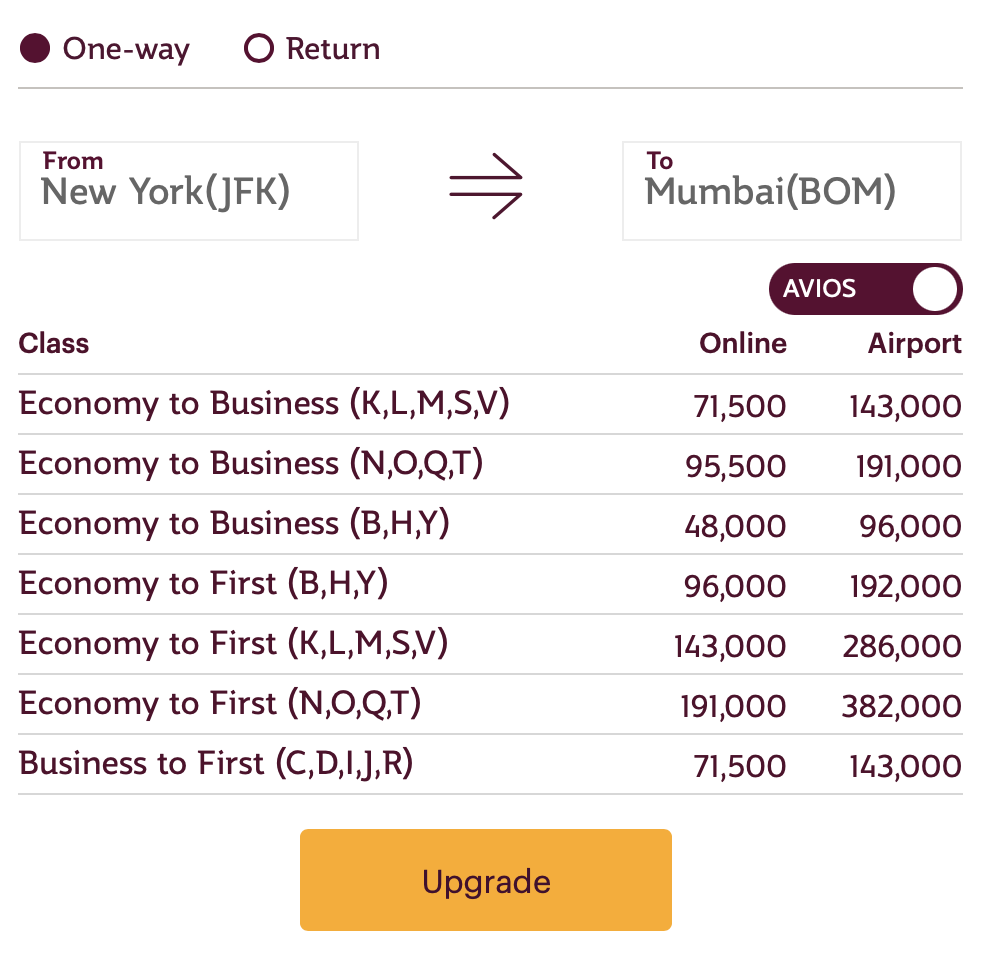
As you can see, Qatar charges much more for an upgrade at the airport than for one online. So, don't wait until the airport to upgrade your flight.
When It Makes Sense To Upgrade With Miles
It's easy to get trapped in the weeds. You don't have unlimited miles, so you'll always calculate whether a redemption makes sense. How much are rewards worth if I book a business class award seat? How much are they worth if I pay for an economy seat and use miles to upgrade? Would they be worth more if I booked through an airline partner? If so, would I still be able to upgrade my seat?
Whether the airline uses an award chart or employs dynamic pricing for an upgrade, you can quickly calculate whether an upgrade makes sense by multiplying the mileage cost of an upgrade by how much you value your miles. For instance, if you value
However, keep in mind that the math isn't always necessary to determine whether it makes sense to upgrade. Sometimes, all you need to do is ask yourself, “Does the cost to upgrade seem reasonable?” If so, it's likely worth it. If not, then it's worth passing on and redeeming your miles another day.
Also, factor in your comfort and travel goals. If you are attempting to upgrade to Singapore Suites to get halfway around the world, it could be worth a surcharge, even if your value per mile isn't the best. If you are considering an upgrade to a dated business class on a 15-year-old plane for a five-hour flight, it might not be worth an exorbitant number of miles. Ultimately, relying on your gut instinct will guide you to the right conclusion on most occasions.
Final Thoughts
Getting to the front of the plane to enjoy business or first class is the name of the game for many points-and-miles fans. But if you don't have enough miles for a premium-cabin award flight, purchasing an inexpensive economy or premium economy seat and upgrading with miles can be the perfect solution. It can also help you get around limited seat inventory for premium redemptions with some airlines.
But remember, treating every opportunity to upgrade on a case-by-case basis is worth the time and effort. Don't redeem more miles and pay more out of pocket than you should.
Page Contents