






AwardWallet receives compensation from advertising partners for links on the blog. The opinions expressed here are our own and have not been reviewed, provided, or approved by any bank advertiser. Here's our complete list of Advertisers.
Flight delays and cancellations are frustrating enough on their own, but they can also get expensive fast.
I ran into this firsthand on a direct Volotea flight from Athens to Palermo. What started as a one-hour delay stretched to nearly four before we finally took off, throwing off my plans to meet an AwardWallet teammate for a week of sun and pasta.
The upside? Because the flight was within the European Union, I was eligible for compensation under EU passenger rights rules — something many U.S. travelers may not be aware of.
Those protections can make a big difference, but they vary widely depending on where you’re flying and what went wrong. Your right to airline compensation depends on the airline you fly, your departure and destination, and whether you are flying domestically or internationally. In light of the different rules for each country and carrier, we’ve grouped them by region and flight type.
Here’s what to know about your rights, and what you may be owed, when your flight is delayed, canceled, or overbooked.
Related: How I Leveraged a $58 Basic Economy Flight Into 40,000 Miles in Compensation
Claiming Compensation on U.S. Domestic Carriers and Flights
Passengers in the U.S. have no blanket protection against delayed or canceled flights like their counterparts in Europe. The U.S. Department of Transportation regulations state:
“Each airline has its own policies about what it will do for delayed passengers waiting at the airport; there are no federal requirements.”
“Contrary to popular belief, for domestic itineraries, airlines are not required to compensate passengers whose flights are delayed or canceled.”

That said, you can ask airline agents for help with food, transportation, and accommodation, but it's at the airline's discretion. To learn more, you can check out our post on requesting compensation from hotels and airlines.
DOT rules only protect passengers in the following situations:
- Tarmac delays: Aircraft cannot remain on the tarmac for more than three hours unless the pilot determines it’s unsafe to disembark passengers or air traffic control advises the plane may not return to the gate. However, the airline must provide you with adequate food and water within the first two hours of a tarmac delay.
- Involuntarily denied boarding: While the rate of involuntary bumping is down to 1/10,000 passengers on domestic flights, with 700 million domestic passengers carried last year, that adds up to tens of thousands of passengers left stranded at the gate. If you are involuntarily bumped from a domestic flight, here's what you’re entitled to:
- Less than one-hour arrival delay: No compensation
- One to two-hour arrival delay: 200% of one-way fare (but no more than $1,075)
- Over two-hour arrival delay: 400% of one-way fare (but no more than $2,150)
How To Get Compensation for Delayed International Flights From the U.S.
Like domestic itineraries, there are no federal requirements for delayed or canceled flights leaving the U.S. When it comes to tarmac delays and denied boarding, the time limits and coverage amounts are slightly different.
- Tarmac delays: Aircraft cannot remain on the tarmac for more than four hours unless the pilot determines it’s unsafe to disembark passengers, or air traffic control advises the plane may not return to the gate.
- Involuntarily denied boarding: International passengers can claim the following compensation if they get bumped from a flight due to overbooking.
- Less than one-hour arrival delay: No compensation
- One to four-hour arrival delay: 200% of one-way fare (but no more than $1,075)
- Over four-hour arrival delay: 400% of one-way fare (but no more than $2,150)
While the U.S. government isn't particularly strong on passenger protections, international flights departing the U.S. are covered by the Montreal Convention, which offers extra coverage. The Montreal Convention covers passengers flying between 143 member countries (including the U.S.) for losses or damages arising from delayed or canceled flights and lost or delayed luggage. If the only consequence of a flight delay or cancellation is that it's inconvenient, that won't be enough to enact the Montreal Convention. There must be losses from items such as pre-booked accommodation, connecting flights, car rentals, etc.
Under the Montreal Convention, compensation limits are set in Special Drawing Rights, an IMF-defined reserve asset whose value is based on a basket of major currencies. The SDR–USD rate fluctuates daily, so always check the IMF’s current valuation page. For flight delays, the current liability limit is 6,303 SDR per passenger, with actual amounts paid in your local currency using the prevailing exchange rate.
Note: The Montreal Convention applies to international carriage — including domestic legs that are part of an international itinerary — but not to purely domestic trips with no international stopover or onward international segment.
How To Get Compensation for a Delayed Flight Departing (or Within) Europe
European Union legislation (specifically EC261) covers flights between EU member countries, within member countries, departing from member countries, and flights on EU-licensed carriers flying into the EU. You may be entitled to compensation if you arrive at your final destination three or more hours late, depending on your flight distance, route, and whether the delay was caused by “extraordinary circumstances” outside the airline’s control. The affected itinerary must also fall under a single reservation.
Causes for delays or cancellations generally can’t involve extraordinary circumstances like severe weather, air traffic control restrictions, medical emergencies, or political instability.
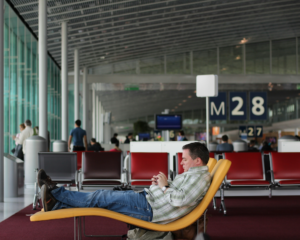
In Europe, airlines are also required to provide care while you wait for a new flight, including:
- Refreshments
- Food
- Accommodation (if you are rebooked to travel the next day)
- Transport to your accommodation and return to the airport
- Two telephone calls, fax messages, or emails
Flight delays
Compensation for delays and involuntarily denied boarding is based on both the distance flown and the origin of the flight:
- €250 (about $270) for flights of 1,500 km or less
- €400 (about $430) for flights of 1,500-plus km within the EU and all other flights between 1,500 and 3,500 km
- €600 (about $650) for flights of 3,500-plus km
If the carrier offers you rerouting and you reach your final destination with a delay of between three and four hours on a flight of more than 3,500 km, the compensation may be reduced by 50%. You can find all the relevant information on claiming compensation at Europa.eu.
Flight cancellations
Compensation for flight cancellations is even more complicated. It is based on when you are notified of the cancellation, whether the airline reroutes you to a different flight, and what time you arrive at your destination. The distances and compensation amounts remain the same, but the timing of your notification of the change and your arrival at your destination are also factored into the re-routing requirements. You won't receive compensation if you are:
- Notified more than 14 days in advance.
- Notified between two weeks and seven days before scheduled departure, and rerouting allows you to depart no more than two hours before the original departure and reach your final destination less than four hours after the originally scheduled time of arrival.
- Notified less than seven days before the scheduled departure, and rerouting allows you to depart no more than one hour before the original departure and reach your final destination less than two hours after the originally scheduled time of arrival.
Confused yet? It’s a lot to take in! If you're looking for more details, this post does a great job summarizing EU compensation rules. If you're trying to understand your rights in a specific travel situation, the Europa.eu site offers an interactive survey to guide you to the relevant information.
Regardless of where you are or where you're heading, it's never a bad idea to have a backup plan waiting in the wings. As we're probably all aware, extenuating circumstances can arise, such as bad weather or mechanical issues. So if you're traveling somewhere you can't afford to show up late, make sure you have a backup plan using points and miles that lets you cancel at the last minute if you don't need it.
Let Someone Else Handle Your Claim (For a Fee)
The different rules and regulations for each region and carrier are enough to give you a headache at the best of times. If you're having trouble wrapping your head around the legislation — or you simply don’t have enough time to go through the process — a handful of companies can help you file a claim.
One company you can use is AirHelp. Simply submit all of the details, and AirHelp will do all of the heavy lifting for you. Representatives will check whether your delay or cancellation warrants compensation, contact the airline directly on your behalf, negotiate a settlement, and, if necessary, take the airline to court.

AirHelp’s standard service fee is 35% of any compensation it recovers. If legal action is required, AirHelp charges an additional 15%, bringing the total fee to 50%. There’s no upfront fee, and if AirHelp doesn’t recover compensation, you don’t pay.
Although I decided to use AirHelp, there are many alternative services out there that can help you with your claim:
Before using any of the above services, carefully review their terms and conditions, fees, and success rates. Additionally, be aware that these services may not be necessary in every situation. And you can often pursue compensation directly with the airline by knowing your rights and relevant regulations, such as EU Regulation 261/2004 for flights within the European Union.
Related: AirHelp Can Pay You During Flight Problems
Take Advantage of the Travel Insurance Offered by Your Credit Card
If you pay for your flight (or the taxes and fees on an award ticket) with the right card, you may have access to extra trip protections. Coverage can apply if you experience delays, cancellations, or baggage issues.

Chase is a top card issuer for travel protections, with several cards offering built-in coverage. Here are a few of our favorites to use when paying for flights:

$95Rates & Fees
- 5X points on Lyft rides through September 2027
- 5X points on travel purchased through Chase Travel℠
- 3X points on dining at restaurants worldwide
- 3X points on gas and EV charging
- 3X points on vacation homes at top brands like Airbnb, Vrbo and more
- 3X points on eligible streaming services
- 3X points on online grocery purchases (excluding Target, Walmart, and wholesale clubs)
- 2X points on all other travel
- 1X point per dollar spent on all other purchases

$795Rates & Fees
- 8x points on all purchases through Chase Travel℠
- 4x points on flights and hotels booked directly
- 3x points on dining worldwide
- 1x points on all other purchases

$95Rates & Fees
- 3X points per $1 on the first $150,000 spent in combined purchases on travel, shipping purchases, Internet, cable and phone services, advertising purchases made with social media sites and search engines each account anniversary year
- 1X point per $1 on all other purchases
Related: How To File a Flight Delay Claim With Chase
Final Thoughts
Knowing when to claim compensation from an airline is an essential part of the
Page Contents
- Claiming Compensation on U.S. Domestic Carriers and Flights
- How To Get Compensation for Delayed International Flights From the U.S.
- How To Get Compensation for a Delayed Flight Departing (or Within) Europe
- Let Someone Else Handle Your Claim (For a Fee)
- Take Advantage of the Travel Insurance Offered by Your Credit Card
- Final Thoughts
For rates and fees of the cards mentioned in this post, please visit the following links: Chase Sapphire Preferred® Card (Rates & Fees), Chase Sapphire Reserve® (Rates & Fees), and Ink Business Preferred® Credit Card (Rates & Fees)