




AwardWallet receives compensation from advertising partners for links on the blog. The opinions expressed here are our own and have not been reviewed, provided, or approved by any bank advertiser. Here's our complete list of Advertisers.
Since early 2020, Bask Bank® has offered savers a mileage-earning savings account that earns
If you don’t already have a Bask Mileage Savings Account, now is the perfect time to apply. Through November 30, 2026, Bask Bank is offering 20,000 AAdvantage®
Should You Earn Miles Instead of Interest?
During the low-interest-rate periods of 2020 and 2021, earning AAdvantage® miles on your savings was a no-brainer. Rather than earning less than 1% APY interest, you could earn AAdvantage® miles worth much more than one cent each.
Then, interest rates rose dramatically from mid-2022 to late 2023, making it a tougher decision between earning miles or cash interest. More recently, the dynamic has reversed. The Federal Reserve has lowered interest rates several times over the last couple of years — before raising it for the first time in years this week.
That makes now a great time to revisit when it makes sense to earn miles instead of cash interest. Depending on your situation, keeping your savings in a Bask Mileage Savings Account can be “miles” ahead of holding your savings in a typical interest-earning account. Let's break down the math to help you determine which is better for your situation.
How Many AAdvantage® Miles Can I Earn On My Savings?
Bask Mileage Savings Account customers earn 1.75 AAdvantage® miles per dollar saved annually. And there's no cap on how many AAdvantage® miles you can earn. At current earning rates, you would earn 87,500 AAdvantage® miles annually if you deposit $50,000 into a Bask Mileage Savings Account.
And through November 30, 2026, new account holders can earn 20,000 AAdvantage® bonus miles by opening a new Bask Mileage Savings Account and holding $50,000 or more in the account for 90 consecutive days.
How does that stack up against earning interest in a typical savings account? Let's take a look.
Is Earning AAdvantage® Miles on Savings Better Than Earning Interest?
Before we dig into the math, remember that each person's situation is different. There may be situations where earning interest on a certificate of deposit or a high-yield savings account makes more sense than earning AAdvantage® miles.
With interest rates increasing once again, the situation is changing quickly.
But even compared to an account earning 4% Annual Percentage Yield (APY), we can make a case for earning miles over interest; we think there are plenty of opportunities to get outsized value from your AAdvantage® miles, and the bonuses on offer present a unique chance to bank a huge number of miles on your savings.
Let’s consider a 4% APY savings account to illustrate the tradeoff between earning AAdvantage® miles and interest.
If you deposited $50,000 for 12 months, you would earn:
- 4% APY savings account: $2,000 in interest
- Bask Mileage Savings Account: 87,500 AAdvantage® miles
Valuing AAdvantage® miles
To get an accurate read on whether it’s better to earn miles or interest, we need to assign a value to those miles. AAdvantage® miles are commonly valued at around 1.7 cents per mile — although AwardWallet users average 2.56¢ per mile in actual redemptions.
As we show in the section below, it’s not hard to leverage AAdvantage® miles for better than 2¢ per mile in value. But, for calculation purposes, we’ll value AAdvantage® miles at a conservative 1.7¢ each, meaning the 87,500 miles earned on your $50,000 deposit would be worth roughly $1,500.
But isn't $2,000 cash interest better than $1,500 worth of miles?
The tax impact
Taxes are another important consideration. With a traditional savings account, your bank will issue a Form 1099 for the value of interest earned. At 4% APY on a $50,000 balance, you’d earn $2,000 in interest — all of which is considered taxable income.
Bask Bank will also issue a 1099 tax form for the value of AAdvantage® miles earned. Bask Bank has historically valued AAdvantage miles at just 0.42 cents per mile. While this value is subject to change, we’ll use that number for our comparison to the cost of earning traditional interest.
If you earn 87,500 AAdvantage® miles in your first year, you'll be taxed on $368 in income. You'll need to factor in your tax bracket to determine the amount you actually owe the government. The amount reported on your Form 1099-INT tax form is the additional income on which you owe tax — not the amount you will need to pay.
Running the numbers
Now that we have the pieces, let's walk through the after-tax value of earning cash interest vs. AAdvantage® miles for this example.
4% APY at a 35% marginal tax rate:
- 4% APY interest on $50,000 is $2,000 (taxable income)
- 35% of $2,000 is $700 (the amount you owe the government)
- Your net gain is $1,300 ($2,000 – $700)
Bask Mileage Savings Account at a 35% marginal tax rate:
- 87,500 AAdvantage® miles are valued at $368 (taxable income)
- 35% of $368 is $129 (the amount you owe the government)
- 87,500 AAdvantage® miles are worth $1,488 (using an assumed 1.7¢ per mile valuation)
- Your net gain is $1,359 ($1,488 – $129)
Comparing the two options, we get:
- Bask Mileage Savings Account: $1,359 (value of miles after deducting taxes)
- 4% APY savings: $1,300 (value of earnings minus taxes paid)
The argument for earning AAdvantage® miles is even stronger if you can redeem them for more than 1.7¢ each, if you have a marginal tax rate of more than 35%, or if you can't earn 4% APY.
On the other hand, you may prefer to earn cash interest if your tax rate is much lower or you aren't confident that you can redeem AAdvantage® miles for a high value.
Here's a comparison of earning AAdvantage® miles vs. cash interest for a variety of mileage valuations and tax rate combinations.
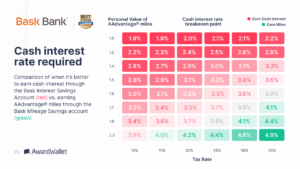
Does the cash interest option win out in your situation? Check out the Bask Interest Savings Account, which is currently offering 3.75% APY.
Get Outsized Value From Your AAdvantage® Miles
Plenty of American Airlines redemption options offer better than 2¢ per mile — even when redeeming economy awards. Here are a few examples to demonstrate the kind of returns you can expect from your miles if you leverage American Airlines sweet spots, deals, or find the right routing and cabin-class combinations.
Round-trip New York to Buenos Aires in economy (2.65¢ per mile)
Using American Airlines' calendar function, you can find round-trip economy awards from New York (JFK) to Buenos Aires (EZE) for 44,000 AAdvantage® miles, plus a reasonable $101 in taxes and fees.
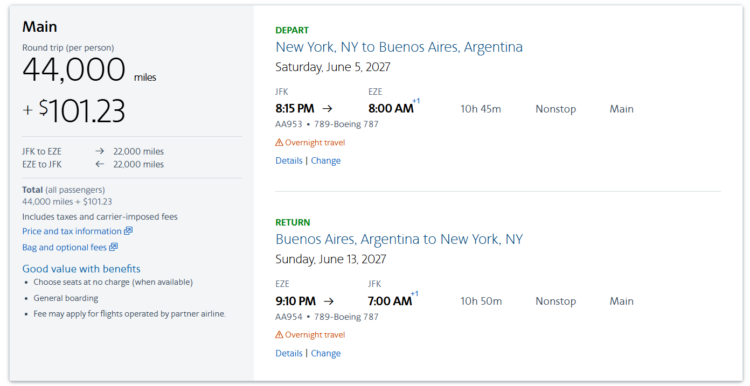
Note that this award does not book into American Airlines Basic Economy. American Airlines awards book into Main Cabin — which offers the regular perks of choosing a seat and getting one free checked bag per passenger. Since American Airlines permanently eliminated fees to redeposit miles when canceling an AAdvantage® award, it makes more sense to book award tickets.
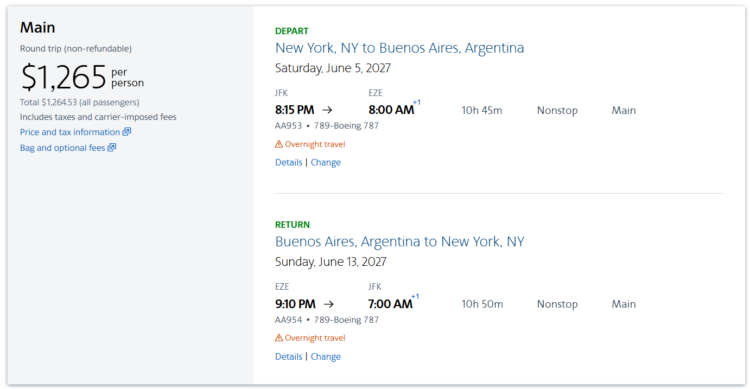
Comparatively, you'd need to pay $1,265 for Main Cabin economy cash flights on the same dates. That nets a redemption rate of 2.45¢ per mile ($1,265 – $101 in taxes = $1,164 / 44,000 miles = 2.65¢ per mile).
One-way international flight (e.g., New York to Auckland)
Whether you're moving or piecing together a round-the-world trip, miles can provide a much better deal when you need to fly one-way internationally. Although American sometimes offers a small discount on round-trip award bookings, there's usually not much of a penalty for booking one-way awards.
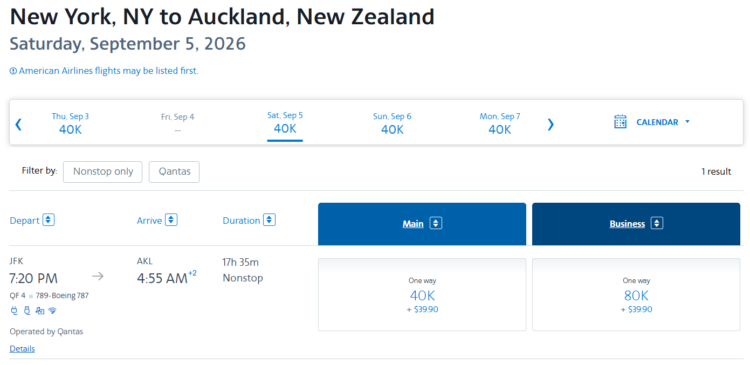
Unfortunately, the same can’t be said for revenue fares, with one-way flights often dramatically more expensive when you pay cash.
In the example above, flying from New York to Auckland will set you back 40,000 AAdvantage® miles, plus $39.90 in taxes in economy. The cheapest cash alternative flight is $1,455 one-way, returning 3.53¢ per mile on an economy award ($1,455 – $40 in taxes = $1,415 / 40,000 miles = 3.53¢ per mile).
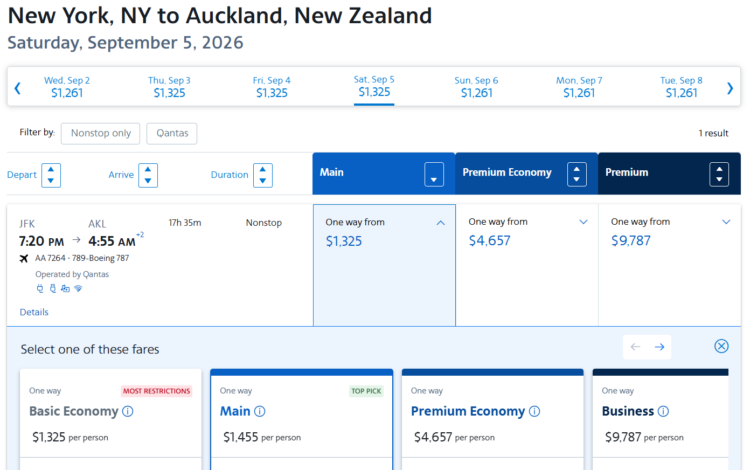
And that's just for an economy award. If you're considering paying for a premium cabin, miles get much more valuable:
- Business class: 80,000 miles + $39.90 taxes/fees vs. $9,787 = 12.2 cents per mile
Round-trip Miami to Vail in economy (3.7¢ per mile)
You can find fantastic value with AAdvantage® miles, even on domestic awards. Again this winter, American Airlines is operating nonstop flights from Miami to Vail. Cash prices certainly reflect the premium route, with some round-trip routes costing $896 round-trip:
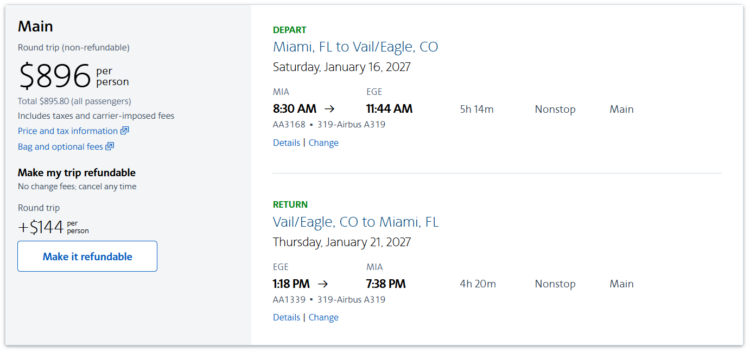
But you can get an even better deal with AAdvantage® miles, with round-trip awards starting at 24,000 miles plus $11.20 round-trip.
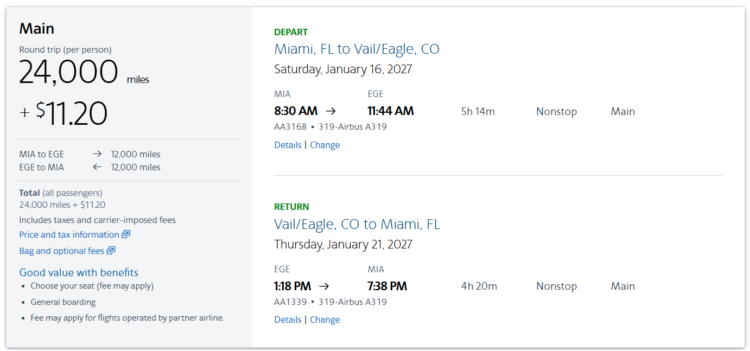
That nets a redemption rate of 3.7¢ per mile ($896 – $11.20 in taxes = $885 / 24,000 miles = 3.7¢ per mile). And this hot deal is during ski season.
Final Thoughts
With the opportunity to earn a lucrative bonus of 20,000 AAdvantage® bonus miles — now available through November 30, 2026 — this is the perfect time to consider opening a Bask Mileage Savings Account. If you can meet the $50,000 deposit requirement for this bonus and keep those funds in the account for 90 consecutive days, you could earn enough miles for a long-haul business-class flight.
And even a small deposit with Bask Bank can be a great way to supplement other miles-earning strategies. Since Bask awards AAdvantage® miles at the end of each month, even a small savings balance can generate the account activity needed to keep your AAdvantage® miles from expiring.
That's a much better return on your funds than earning interest in our book!
Terms & Disclosures:
Bask Bank is a division of Texas Capital Bank, Member FDIC.
Mile awards are subject to change at Bask Bank's sole discretion. Please see Terms and Disclosures for details.
American Airlines reserves the right to change the AAdvantage® program and its terms and conditions at any time with or without notice, and to end the AAdvantage® program with six months' notice. Any such changes may affect your ability to use AAdvantage®
American Airlines, AAdvantage®, the Flight Symbol logo and the Tail Design are marks of American Airlines, Inc.