


AwardWallet receives compensation from advertising partners when you visit our site, click on a link, when you are approved for a credit card, or when an account is opened. Terms Apply to the offers listed on this page. Enrollment is required for select Amex benefits. The opinions expressed here are our own and have not been reviewed, provided, or approved by any bank advertiser. Here's our complete list of Advertisers. Offers for Bank of America cards mentioned in this post have been updated as of 01/02/2025

Offers for the Bank of America® Premium Rewards® credit card and Citi Prestige® Card are not available through this site. Some offers may have expired. Please see our card marketplace for available offers

Paying the IRS is never fun. The silver lining? Owing money on your taxes presents a fantastic opportunity to earn points and miles by paying taxes with a credit card.

Most Americans only deal with paying taxes once per year on April 15. However, self-employed and contract workers also need to make estimated quarterly tax payments throughout the year. And the payment for both types of taxpayers is coming up on April 15, 2026.

With the lowest processing rate again set at 1.75% in 2026, you can actually profit from paying taxes with a 2% cash-back credit card!

However, the IRS is only partnering with two payment processors again in 2026 — instead of three in the past. This is bad news for those of us who like to split tax payments across multiple credit cards to meet minimum spending requirements across several cards. Also, Pay1040 is still charging a much higher fee on business cards and all American Express cards.

In this post, we’ll cover everything you need to know about paying taxes with a credit card so you can build up those points balances.

What Is the Fee for Paying Taxes With a Credit Card?

As outlined on the IRS website, taxpayers have two options to pay the IRS online with a credit card. Each payment processor charges a different fee for paying federal income taxes, depending on the type of card you use.

  • Pay1040: 1.75% fee with a $2.50 minimum — but 2.89% for business cards and all Amex cards
  • ACI Payments, Inc.: 1.85% fee with a $2.50 minimum

Starting in early 2025, Pay1040 dropped its headline fee from 1.87% to 1.75%, and ACI Payments decreased its fees from 1.98% to 1.85%. Both maintain a $2.50 minimum fee. However, the IRS webpage now lists much higher fees both payment processors when paying by “corporate credit or debit card”:
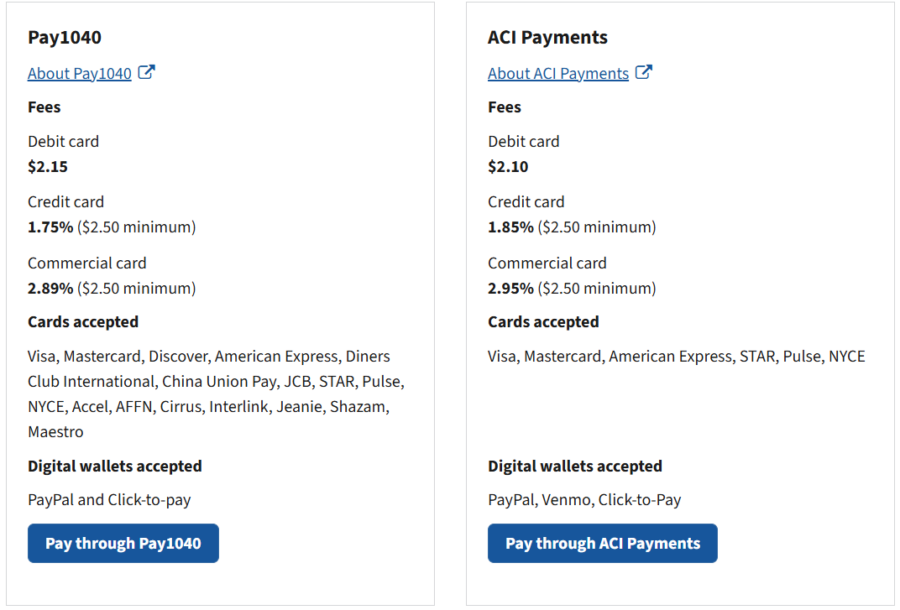
screenshot of payment processors and fees to pay taxes with a credit card
Screenshot of IRS website

Also, the IRS no longer lists PayUSAtax as a tax payment processor. This is a bummer, as PayUSAtax previously offered the cheapest rates for paying federal taxes.

The IRS website also offers a table comparing debit and credit card payment processing fees assessed by each processor at various dollar amounts:

Payment AmountPay 1040 - Debit Card FeePay 1040 - Credit Card FeeACI Payments - Debit Card FeeACI Payments - Credit Card Fee
$50$2.15$2.50$2.10$2.50
$100$2.15$2.50$2.10$2.50
$250$2.15$4.37$2.10$4.62
$1,000$2.15$17.50$2.10$18.50
$2,500$2.15$43.75$2.10$46.25
$10,000$2.15$175$2.10$185

Watch out for the minimum processing fees. If you pay $127 or less, you'll pay a higher processing fee rate than the 1.75%–1.85% rate listed. To pay the lowest rate of 1.75% through Pay1040, you'll need to pay at least $143.

Generally, you can expect two charges on your credit card statement. The tax payment may appear as “United States Treasury Tax Payment,” while the processing fee may be charged as “Tax Payment Convenience Fee.”

Screenshot showing tax payment via credit card plus how the transaction fee is charged

Will I be charged a cash advance fee for paying my taxes with a credit card?

Both payment processors (Pay1040 and ACI Payments, Inc.) confirm that the charge will be processed as a purchase and not a cash advance, so you won't have to worry about extra fees. With that said, you can always request that your card issuer lower your cash advance credit line low enough that you can be sure that the payment doesn't credit as a cash advance.

Maximizing Rewards With an IRS Credit Card Payment

The size of your federal tax obligation and the credit cards you have are two key components of approaching your tax payment. Taxpayers looking to maximize the rewards from their federal tax payment should consider the following strategies:

Earn a sign-up bonus when you pay the IRS with a credit card

In recent years, credit card sign-up bonuses have swelled in size. But so have spending requirements. Previously unheard-of 100,000-point sign-up bonuses are much more commonplace. However, some of these bonuses have very high spending requirements across a three-month period.

The offer on the Chase Sapphire Reserve® (Rates & Fees) offers a bonus that ticks a lot of boxes: 125,000 bonus points after you spend $6,000 on purchases in the first 3 months from account opening. Cardholders might not typically spend that much in a three-month period. However, a large income tax bill might boost spending enough to meet the bonus threshold.

For instance, putting a $6,000 tax payment on a credit card will cost around $105 through Pay1040. However, it can net 125,000 bonus points for new cardholders. The total points earned from such a purchase would be 6,000 + 105 + 125,000 = 131,105 points!

Even if you redeem these points for just 1 cent each, that's over $1,300 in value from this one payment! That's much more than the $105 processing fee paid. Plus, you can get much more value from these points by redeeming them through Chase transfer partners. For context, AwardWallet users tend to redeem Chase points at 2.01¢ apiece.

Chase Sapphire Reserve®
Welcome Bonus Earn 125,000 bonus points after you spend $6,000 on purchases in the first 3 months from account opening.
Chase Sapphire Reserve®
Welcome Bonus Earn 125,000 bonus points after you spend $6,000 on purchases in the first 3 months from account opening.
Annual Fee:$795
Show moreWhy We Like ItHighlightsEarning Rates
Chase's flagship Ultimate Rewards card. You get a $300 travel credit, airport lounge access courtesy of a Priority Pass membership and industry-leading travel insurance benefits. New cardholders earn 125,000 bonus points bonus points after you spend $6,000 on purchases in the first 3 months from account opening.
  • Earn 125,000 bonus points after you spend $6,000 on purchases in the first 3 months from account opening.
  • Get more than $2,700 in annual value with Sapphire Reserve.
  • Earn 8x points on all purchases through Chase Travel℠, including The Edit℠ and 4x points on flights and hotels booked direct. Plus, earn 3x points on dining worldwide & 1x points on all other purchases
  • $300 annual travel credit as reimbursement for travel purchases charged to your card each account anniversary year.
  • Access over 1,300 airport lounges worldwide with a complimentary Priority Pass™ Select membership, plus every Chase Sapphire Lounge® by The Club with two guests. Plus, up to $120 towards Global Entry, NEXUS, or TSA PreCheck® every 4 years
  • Get up to $150 in statement credits every six months for a maximum of $300 annually for dining at restaurants that are part of Sapphire Reserve Exclusive Tables.
  • Count on Trip Cancellation/Interruption Insurance, Auto Rental Coverage, Lost Luggage Insurance, no foreign transaction fees, and more.
  • Get complimentary Apple TV+, the exclusive streaming home of Apple Originals. Plus Apple Music - all the music you love, across all your devices. Subscriptions run through 6/22/27 - a value of $250 annually
  • Member FDIC
  • 8x points on all purchases through Chase Travel℠
  • 4x points on flights and hotels booked directly
  • 3x points on dining worldwide
  • 1x points on all other purchases

Hit a spending threshold by paying taxes with a credit card

For those not looking for a new credit card, there are still potential milestone spend levels that earn notable travel perks. For example, Hilton Honors American Express Surpass® Card cardholders earn a Free Night Reward after spending $15,000 on purchases on their card in a calendar year.

You can pay just $277.50 in fees to make a $15,000 tax payment through ACI Payments (Note: Pay1040 is charging a much higher 2.89% fee on Amex cards). The ability to earn a free night valid at almost any Hilton portfolio property worldwide at this price can be an absolute steal. Many of Hilton's luxury hotel properties charge rates two to three times higher than this processing fee per night.

Don't forget that you'll also earn 45,000 Hilton Honors points — worth around $261, based on recent AwardWallet user redemptions — on the purchase. That value alone almost covers the $277.50 cost of paying your taxes on this credit card.

Related: Why I Spend $15,000 Each Year on My Hilton Surpass Card

Pay taxes with a credit card that earns more points

Points and miles enthusiasts with no welcome bonus or spend threshold to meet should look to maximize the rewards from their expenses. Federal tax payments are no exception. Unfortunately, no credit card issuers offer a bonus category for paying taxes. Therefore, taxpayers should follow the same rules of thumb they typically follow for non-bonus spending.

For American Express Membership Rewards enthusiasts, The Blue Business® Plus Credit Card from American Express credit card will earn 2X Membership Rewards points on the first $50,000 of spend in a calendar year, then 1 point per dollar above that.

If you want 2x earnings with no cap, consider paying your taxes with the Capital One Venture X Rewards Credit Card or Capital One Venture Rewards Credit Card. Both cards earn an unlimited 2x Capital One miles on every purchase. Worst case, you can use miles at 1 cent each to pay for travel. That means you're getting at least 2% back on every purchase.
Capital One Venture Rewards Credit Card
Welcome Offer Earn 75,000 bonus miles once you spend $4,000 on purchases within the first 3 months of account opening, plus receive a $250 Capital One Travel credit in your first cardholder year.
Capital One Venture Rewards Credit Card
Welcome Offer Earn 75,000 bonus miles once you spend $4,000 on purchases within the first 3 months of account opening, plus receive a $250 Capital One Travel credit in your first cardholder year.
Annual Fee:$95
Show moreWhy We Like ItHighlightsEarning Rates
Following the revamp of Capital One's rewards program and the addition of airline transfer partners, the Capital One Venture has catapulted into our list of top travel rewards cards. The ability to earn at least 2X miles on every purchase provides a decent return on spending. Plus the card offers some great perks.
  • Earn 75,000 Miles once you spend $4,000 on purchases within the first 3 months of account opening, plus receive a $250 Capital One Travel credit in your first cardholder year
  • 5X miles on hotels, vacation rentals and rental cars booked through Capital One Travel
  • 2X miles on all other purchase
  • Fee credit for Global Entry or TSA Pre✔® (up to $120)
  • No foreign transaction fees
  • $95 annual fee
  • 5X miles per dollar on purchases through Capital One Entertainment
  • 5X miles per dollar on hotels, vacation rentals and rental cars booked through Capital One Travel
  • 2X miles per dollar on all other purchases

Meanwhile, Chase loyalists have the potential to earn 1.5X Ultimate Rewards points by paying with the Chase Freedom Unlimited®. If you plan to use a Freedom Unlimited to pay your federal income taxes and redeem these points through the Chase Travel℠ portal, holding a Chase Sapphire Preferred® Card or Chase Sapphire Reserve® as well is key. Having either card will unlock the ability to transfer points to Chase Ultimate Rewards transfer partners.

Or Sapphire Reserve cardholders can redeem Ultimate Rewards points for up to 2 cents each through Chase's travel portal. Earning 1.5X points redeemable for up to 2 cents each means an overall spending reward of 3%. At a 1.25-cent redemption value, the spending nets a 1.875% return — which is just barely enough to cover the processing fee.

Alternatively, federal tax obligations might offer a great way to top up your points or miles balance. That can be especially helpful if you need to boost a specific hotel or airline program that's not available as a transfer partner of any of the major credit card issuers.

Collectors of Citi ThankYou® Points who hold both a Citi Double Cash® Card and a Citi Strata Premier® Card or Citi Prestige® Card card can earn 2X ThankYou® Points paying their taxes with their Citi Double Cash, which has no annual earning limits.

Earn cash back for paying taxes with a credit card

If you already have enough miles or are short on cash, points and miles may take a backseat. Instead, taxpayers might seek out the best available cash-back rewards from credit card spend. Thankfully, there are several credit cards that offer 2% or greater cash back on all purchases.

In addition to the aforementioned Citi Double Cash, the Capital One Spark Cash Plus also offers unlimited 2% cash back on all purchases. The American Express Blue Business Cash™ Card also earns 2% cash back on all eligible purchases on up to $50,000 per calendar year, then 1% (issued as a statement credit). Even using the payment processors with the highest 1.85% fee means those earning 2% cash back will come out ahead on their tax payment.

Those who hold the Bank of America® Premium Rewards® credit card can potentially earn even more than 2% cash back. While the card earns 1.5% cash back on general purchases, those with significant assets with Bank of America and related accounts earn up to a 75% bonus on these earnings, thanks to the Bank of America Preferred Rewards program. Cardholders with high enough savings can earn up to 2.625% cashback on their federal tax payments.

Given the $100,000 asset requirement to reach that reward level, this option isn't for everyone. But for those with enough savings, this is an incredible earning rate!

Related: All the Ways To Save When Doing Your Taxes

Other Benefits of IRS Credit Card Payments

Tax payments can be split between multiple credit cards. That can be especially helpful for those with high tax obligations. This provides taxpayers the opportunity to earn multiple credit card sign-up bonuses — perhaps one card apiece for those married filing jointly. Alternatively, you can split payments to reach the spending requirement on one sign-up bonus and then work toward a different credit card's spending threshold with the remainder of the payment.

You also can pay with a credit card to help manage cash flow. By paying your taxes with a credit card, you can delay the actual payment by a month or longer. For example, imagine a payment is made on the first day of a billing cycle. When the cycle closes a month later, cardholders generally have another month to pay the credit card “on time.” That means the funds are transferred out of your bank account a full two months after the date you made the tax payment.

Should I Pay Taxes With a Credit Card?

Paying taxes with a credit card can provide a (potentially considerable) net gain for taxpayers. But, two conditions need to be met. First, you need to be able to pay off (in full) the incurred credit card charge when it comes due. Second, the value of the rewards you earn from your payment should outweigh the processing fee.

It doesn't make sense to incur a 1.75% fee if you aren’t getting at least 1.75% worth of credit card rewards on the purchase. If you know which card to use to make a tax payment, you should have no trouble meeting this requirement. 

Will you be paying income taxes with a credit card this year?

For rates and fees of the cards mentioned in this post, please visit the following links: Chase Sapphire Reserve® (Rates & Fees)

Tip of The Day
Did you know that when you delete a travel segment from your Trips timeline, we simply hide it, so that it doesn't automatically import again. If you ever wish to recover that segment, click Show Deleted Segments.
Screenshot of an AwardWallet Trips timeline highlighting the option to click "show deleted segments"

The comments on this page are not provided, reviewed, or otherwise approved by the bank advertiser. It is not the bank advertiser's responsibility to ensure all posts and/or questions are answered.

157

Your email address will not be published. Required fields are marked *

Comments

  • STEPHEN says:

    That Citi ThankYou points earning strategy should also work for holders of the Citi Strata Elite using a Citi Double Cash.
    Another option would be to pay taxes using Wells Fargo Active Cash Visa Signature unlimited 2% cash back then transfer the cash back into Autograph or Autograph Journey points balance for transfer to Wells Fargo airline partners.

  • Madeleine says:

    Capital one Spark business card counts tax payments to meet the introductory offer as of march 2025. The convenience fee is higher than the 2% rebate though with pay1040. and ACI Payments doesn’t accept business card to pay personal federal taxes.

  • Dan says:

    Is it possible to pay your tax bill with PayPal but have an AmEx card linked to PayPal to get around the elevated fee with AmEx if you pay directly with the IRS?

  • Edward says:

    The fee information here ( and IRS site ) seems incorrect. The fee stated on the actual processors’ sites is around 2.85% .

    • JT Genter says:

      Looks like that’s for Amex cards and business cards. I’m digging into it now and will update the post soon.

  • Michele L says:

    Capital One bars payments to the IRS with their Spark card! Regarding points to meet introductory offers, many cards don’t count tax payments toward the “spend requirement” to get the intro offers. Buyer beware. Call the card company and ask!

  • Ken H says:

    Your current info is all wrong. The IRS website still shows PayUSATax as the lowest and Pay1040 is higher than you mention. You might want to check your data source.

  • STEPHEN says:

    Another situation not mentioned in the post – for homeowners (or any property you might own, including commercial) – many jurisdictions allow property taxes to be paid by credit card. One of my real estate company’s properties is in a town that has no processing fee for credit and debit card payments of property taxes (and any other city tax and fee payments). I think some of that town’s elected officials (or an unusually high percentage of the towns residents) must be points and miles enthusiasts. That town is mostly highly paid (as in 6 figures) energy chemical industrial blue collar laborers who get full corporate annual vacation days and monthly holidays. Most jurisdictions charge a convenience fee less than 3%, some less than the fees for federal tax payments.

  • STEPHEN says:

    There is another scenario the article leaves out where paying taxes with a credit card makes sense for an independent contractor – BILT Mastercard – but make the payments on BILT Rent Day. Why?
    – On BILT Rent Day tax payments become part of 2X “all other spend” up to max 10K bonus points each Bilt Rent Day.
    – Deferring these tax payments by a month with a credit card at tax time give room to complete IRA and SEP contributions by their deadlines.
    – Paying the entire years estimated tax payments on BILT Rent Days can fast-track qualification for Silver, then Gold, then Platinum Elite Status with Bilt Rewards BY SPEND ALONE (now possible under Bilt Rewards new 2024 rules, as opposed to by points earn, which would require a whole lot more bonus spend under the new rules). My first quarterly installment this months Rent Day along with last months Bilt Rent Day spend has already qualified me for Bilt Silver Elite on my brand new Bilt Mastercard.
    – BILT Platinum Elite can be status matched for a year of Flying Blue Gold Elite status by transferring 10k Bilt Rewards (can still redeem any way you want that is possible in the Flying Blue program).
    – Buying and flying as few as 3 connecting trips with at least 1 long haul segment in business class on highly competitive (so low priced biz class) routes on any Sky Team carriers with maybe a couple short cheap domestic Delta connecting flights thrown in (all booked through Flying Blue) within a year would earn the 300 EXP (Flying Blue’s elite status metric) needed to upgrade Flying Blue Gold to Flying Blue Platinum status – for a full year!
    – With Flying Blue Platinum Status can now book Air France La Premiere (international First Class) with points transferred from ANY transferrable points credit card that supports Flying Blue, not just BILT Rewards. And, of course, 300 EXP will also come with corresponding redeemable Flying Blue miles (along with the original 10K transfer from Bilt Rewards) that can go towards that La Premiere redemption. In general, ONLY Flying Blue Platinum Elites are granted access to La Premiere award seat availability.

    • STEPHEN says:

      Follow up: This BILT Mastercard strategy no longer works because BILT has now capped the Rent Day bonus to 1000 points. My next tax payments will be Capital One Venture X or AX Blue Biz, and in future may get a Bank of America Travel Rewards or Unlimited Cash Rewards to go with my Merrill SEP (qualifies for 2.65% cash back rate).

    • STEPHEN says:

      UPDATE: my post on BILT Rent Day strategy for paying taxes no longer works (except for tax payments under 500 dollars) because BILT has capped the bonus earn at 1000 points.

  • kripal says:

    will i get 2% cash back on my ventureX federal tax payment ? might be good to use them for BA avois or air france tickets

    • Ryan Smith says:

      Yes, you would earn your normal “Other spending” category on the Venture X, so 2x points per dollar spent.

  • Ed says:

    Amex/Hilton are now rejecting tax payments as counting towards the $15,000 spending target for the Hilton Surpass Card free night stay. I tried recently and they have said it’s not an eligible goods or services transaction.

  • Paul Davis says:

    Spending on the Hyatt Business Credit card to pay my quarterly tax estimates helped get me to globalist status again for next year. worth it!

  • Joel Gilgoff says:

    We have been paying our taxes with a credit card for at least 5 years. We used a Chase credit card and got 1.75% back bonus back.

  • tassojunior says:

    I’ll be paying part year property tax @2.5% ($75) to do spend for the Hyatt 60K biz card. Hyatt has a super sale on points going where 55K is $920. I’m getting 60K for $199 annual fee plus the $75.

  • Tom Thumb says:

    Curious if any W4 / 1040 folks have pumped up their exemptions to minimize their taxes coming out of their paycheck – and then making quarterly estimated tax payments with their credit card?

    • JT Genter says:

      I’ve certainly done that in the past to help hit credit card sign-up bonus minimum spending requirements.

  • Ron Bartholomew says:

    I have an american express delta skymiles card. Should I use it to pay taxes?

    • JT Genter says:

      Depends on your goals! SkyMiles aren’t valuable enough on their own to justify paying taxes with the card. But, if you’re working toward a welcome bonus or towards a Status Boost, it might make sense for you.

  • Gabe says:

    Why can’t the IRS just take credit card payments fee free? My county’s government started doing that for county taxes during the pandemic, which makes paying taxes slightly less painful.

  • Stanley Yee says:

    NJ charges 2% + .50 cents for credit card payments.

  • Edna says:

    Good information. It is a good read and may be helpful to some that wish to pay the IRS with a credit crard.

  • V11 says:

    This year is gone, will use CC next year.

  • Larry says:

    The fees for the paying the taxes seem too high to really be valuable for getting rewards from CC spend. There have to be better strategies available.

  • fernanda andrade says:

    At the very least, you can see something good in the arduous task of paying taxes.

  • Jennifer says:

    I say only do this if you are trying to meeting a spend on your credit card to get a bonus. If you have other things you can spend on, I would do that first.

  • Kevin says:

    Just in time. I received my newly approved AMEX Biz plat today and need to spend $15k in 3 mos. and my friend Simon can’t help. ?

  • Fabio says:

    Good strategy. A good way to ease this obligation to IRS.

  • Bhikhu Shah says:

    I have found that it is not worth paying taxes with credit card. But each to their own.

  • Darren says:

    Would any of this code as an online purchase BoA rewards members could be getting 5.25% back.

  • AJ says:

    I prefer getting money back from the IRS…

  • Wayne says:

    If you use the Bofa premium card and at their highest lvl, you get 2.625% back so its like making $ to pay taxes

    • Karl says:

      Those possessing credit cards with very high rebate rates are truly in luck.

      • Darren says:

        It only takes $100,000 in investments – really not that much for an investments. My question is would this be an “online” purchase where you could get 5.25% cash back.

  • Darren Douglas says:

    Good ideas if you’re considering a new card and need to meet a bonus threshold. My current preferred card is simply 2% cash back, so when I considered using it to pay an IRS bill … it was a wash after processing fees. Nice idea to keep in mind in the future if I open a new card and need to hit a spending threshold.

  • AJ says:

    This is an interesting idea but my preferred award card is Amazon’s and at just 1% it’s not going to catch up to processing fee.

    • Darren says:

      You should definitely add another card to your portfolio. 1.5% cashback should be the floor for everyday/non-category spend.

  • Shaz says:

    I never even thought of doing this! What a great way to earn points. Thanks for the tips! Softens the blow of paying taxes, knowing I’m sending myself on a trip with all my new points haha.

  • David Fuhrer says:

    Very insightful article and very useful idea to use the tax payment for the sign-up bonus. IRS should incentivize credit card payments even more, as I am sure it saves them quite a lot of processing work comparing to receiving millions of checks in the mail.

  • Vero Ferre says:

    Thanks for the guide!! I didn´t know I can earn points by paying taxes!!!

  • JAXBA says:

    I suppose even if only using a 1X reward card, it could be seen as a cheaper way of purchasing points, as a $1000 payment and a $20 fee would earn 1020 points, while buying some airline points can be $50+ for 1000 points. Might be worth considering if you already know you’ll be so many points short of an award in a few months time.

  • Cedric says:

    Thanks for the reminder. I just applied and got approved for the Amex Bonvoy biz card. Unfortunately, I didn’t not receive the instant card number. Will call to see about getting it expedited so that I can pay before the deadline.

  • Nate says:

    Sounds like a possible plan for me next tax season 🙂

  • Kirstin says:

    In Germany you can’t even pay for the rolls at the bakery by credit card.
    Great to see whats possible… even it doesn’t make sense most of the time because of the additional fees

  • Will says:

    I didn’t know that paying taxes can help meet the sign-up bonus requirements for credit cards! I have not thought about that before, but now I can feel a bit better about paying taxes in the future.

  • Maryjane says:

    I’ll be paying a big tax bill soon. If they take Discover, I’ll use that because I’m getting 1.5 per dollar now and they double everything I’ve earned at the end of the first year…essentially earning me 3 percent, I’ll be using those points for an expensive River cruise next year so it will be well worth it. Otherwise I’ll use my Blue for Business Amex.

  • Wade says:

    Great advice – it definitely requires a person who is responsible with credit card usage. If not, it’s a recipe to falling further behind in debt if you aren’t careful.

  • Darren says:

    Speaking of, just got my property tax bill today. It’s paid through escrow but last time I did this I got the PayPay quarterly bonus. The county then saw I was double paid and cut me a check. Earned points on a net zero purchase. Winning!

  • Robert says:

    This is a good strategy. With the correct card, it is not difficult to come out ahead.

  • Chris says:

    Have hit several SUBs over the past few years with tax payments. Easy to knock it all or most of it out with one transaction.

  • Jennifer says:

    I would not use my credit card to pay for income taxes.

  • BW says:

    Wow I never knew it was an option. Great article! I guess it only makes sense in certain circumstances.

  • Matt says:

    Keep in mind that you earn reward on the fee paid too. So even using a 2% card like Citi Double cash earns you more than you might think even with a 1.96% fee. For example, for a $10,000 tax payment, you pay a fee of $196, but then earn 2% on $10,196, or $203.92. So you come out $8 ahead even if you don’t have thresholds to meet.

  • ricardo says:

    Not a bad strategy if you need to make CC spent for a bonus

  • Paul says:

    Thanks for the reminder and how to guide about this

    • Harvey Kwan says:

      If you have high taxes like I do, it’s best to open a Chase Ink Cash or Preferred with their elevated SUBs

  • Andrew says:

    Maybe for a signup bonus if you’re never going to meet the spending threshold but otherwise don’t pay the fees!

  • Kevin says:

    Boo, Pay1040! You used to have the best price. ?

  • Darren says:

    Timely article, thank you. I’ve decreased my withholdings and am finalizing my taxes now. I’m hoping to owe money and use my BoA Premium Rewards card to pay.

  • Mikey says:

    This looks like a viable alternative to meet spending requirements for a credit card sign up bonus if there is no other way to get there, but I’d personally just prefer to avoid the fee and hassle altogether as I usually don’t owe much if any tax to the government come tax season,

  • Charles says:

    “It doesn’t make sense to incur a 1.96% fee if you aren’t getting at least 1.96% worth of credit card rewards on the purchase.”

    That’s precisely the ultimate bottom line.

    Thanks.

  • John Robinson says:

    Nice to know of this option to pay taxes and manufacture some spend… just be sure to keep an eye on the fees, and determine if the cost/mile is worth it in your situation!

  • RJ says:

    Great reminder. I like the daily lifestyle points usage tips!

  • Bhikhu Shah says:

    Too many issues with the cost involved in paying taxes with cc for me.

  • Angelo Fonseca says:

    a less unpleasant way of fulfilling a legal duty.

  • STEPHEN says:

    Some airlines let you earn Elite Qualifying Miles or Elite Qualifying Dollars with credit card spend. So someone whose flying drops below the amount needed to keep status might be able to top it up by paying for taxes with their airline co-brand credit card. For example, $25k In spending on Delta credit cars would hit Delta’s MQD requirement for Medallion status. Or hitting the $50k spend threshold for JetBlue Mosaic using JetBlue credit cards.

    Personally, I think it is cheaper to get elite benefits by a-la-carte purchase as fees with flight tickets, but I can see how this strategy could be worthwhile for a dedicated road-warrior who must fly constantly, but sees a temporary drop in their flying needs for an extended period.

  • Froide says:

    Time to pay my property taxes. I’m keeping my eyes open for Plastiq and Venmo’s periodic fee free deals.

  • Bill Cowell says:

    It is VERY important to make sure one can pay the credit card bill outright when it comes. If not, all of the ‘savings’ will go to waste. It is very easy to more than lose what seemed to be so good! Think it out well – and there are benefits to be had!

  • Karen says:

    This sounds like a good idea to implement.

  • Brijesha says:

    If you are platinum honors at BOFA, 2.625% at BOFA preferred card would be the best option to do it.

  • goldena says:

    Well, I’m paying my taxes with AmEx for a while and can’t say that it’s a very rewarding business but I am always going for every free mile or point just from the love for a game

  • angelo fonseca says:

    Really, paying taxes is unpleasant. But earning miles in this activity makes it less painful.

  • Jennifer says:

    I think this only works out for those that have new credit card bonuses and they are having a hard time on the spend amount required. All others should stay clear of this.

  • Charles says:

    Split credit card payment option is sure a very useful feature.

  • Gilberto Souza de Morais says:

    It is not worth paying taxes with credit cards to get extra points on either frequent flyer or any rewards programs.

  • Steve says:

    The BofA Cash Rewards has 3% cash back in categories that the user chooses from Online Spending, Dining, Drug Stores, Gas, Travel and Home Improvements & Furnishing.

    Is there any chance that the Online Spending category would “cover” the payment of taxes through one of those three?

  • Elise says:

    Started to pay estimated taxes using CC, it is a quick way to reach min spend especially as I’m not traveling as often these days. Also doing split payment with BofA Travel Rewards as the 2nd card is nice since the fees are offset.

  • Fenspinbi says:

    I’ll probably be paying it with a credit card for the first time this year, perhaps with the JetBlue Plus card.

  • Maryjane says:

    I have just opened my first Discover card. If they take discover, I’ll get the 1.5 back initially and again later they’ll double all purchases made in my first year. So this could be a great option for some people.

  • ssss says:

    Are there any credit cards that earn 3% back for paying taxes? Alliant used to, but no longer does.

    • JT Genter says:

      The only way I currently see to get 3% cashback is by signing up for a Discover it Miles and paying taxes in the first year of having the card. The card earns 1.5% but the cashback is doubled for the first year.

  • Barbara Bryant says:

    Does the Capital One Venture Credit Card allow payments to the IRS and its standard 2 points per dollar reward?

    • JT Genter says:

      As far as we know, yes! And that’s an especially great option for those that can maximize Capital One miles through transfer partners.

    • ssss says:

      Yes, and I used paying taxes for the sign-up bonus. The issue I had, was the credit limit, versus the amount I needed to pay for a house sale. I called to tell them I was cycling since I wasn’t doing anything nefarious. The bank had no issue. I prepaid my card by check, which enabled me to override my credit limit and make payments more quickly.

  • Matt says:

    I still find it hard to justify additional fees, even though we may come out ahead “net” wise.

  • Gabriel says:

    At least we can get a benefit when payingt taxes…

  • SunSun says:

    No one likes to pay fees for anything, so it is always based on cost vs. benefit ratio. Use it on transaction when benefit > cost and use it wisely.

  • Shirley says:

    Retired last year. No more withholding. BOA Premium Rewards cards with top tier Platinum Honors=2.625% cash rebate on charges. State, city and fed taxes paid online are a moneymaker. Except that I have to pay taxes to do it.

    • JT Genter says:

      Very nice! If you have the savings to get that top tier, there’s no better cashback option than that BOA Premium Rewards card!

  • David Cheng says:

    Thank you! I will be sure to use a card with at least 2% cash back for my next tax payment.

  • Miya P says:

    Of course i will be pay taxes with a credit card. Can be get many hotel points or airlines miles. can be save money if we have a trip.

  • Logan says:

    Maybe an unpopular opinion but I dont see the value of payng taxes with a mileage-earning credit card if I’m paying an additional fee for the miles.

    • Darren says:

      It depends on what rate you expect to redeem your miles at. If you’d get 1.3cpm on United, you lose but if you’d get 7cpm on American, you win.

  • Florencia says:

    I always pay everything I can with a credit card, any amount, any expense. Everything adds up to millions, do it.

  • David Cheng says:

    Thanks for the info! Are there certain banks that exclude taxes from earning points/cashback?

  • Denise says:

    I always pay taxes–federal, state & property–on credit cards. As a DP, in the past year, I have received City Thank You points for tax payments on a Citi Premier MC and an AT&T and More MC.

  • Freddie says:

    Yes, I usually use Credit card to pay taxes and then earn my Marriott hotel points. Should be a nice way to get more benefit. haha.

  • Ed S says:

    My tax preparer mentioned the fees if I used my credit card and suggested avoiding it, but I did not realize the mileage gains.
    I will definitely utilize this approach in paying my (huge) taxes next year. Great post! Thank you.

  • dphamm says:

    I never thought of paying income taxes with credit card, but i do with property taxes, and i love the benefits from it.

  • Bill from Maine says:

    I have paid my taxes and auto registrations with my credit cards for the last 10 years. In fact, I use a credit card no matter how big (car down payment) or small ($1.00 McDonald’s soft drink). Everything is paid for when the statement comes in.

  • Farid Kassam says:

    Paying taxes by credit card is a good way to rack up points as long as you can pay off the balance in full when the credit card is due.

  • Maryjane says:

    I have been paying my taxes with a credit card for years. Following all the guidelines in the article of course. . It definitely takes the sting out of a large tax bill and you truly are saving a bit of money by doing so.

  • Joel Gilgoff says:

    I’ll be using my and my wife’s Alaska Air credit cards to get 2x 65,000 point sign up bonuses. It’s an amazing deal.

  • Anup says:

    Thanks for the useful information. I might use it at some point if my situation changes.

  • Robert says:

    Many cards offer a better return than 1.87%. Therefore, I think this is a strategy well worth considering.

  • CHARLES S COLEMAN says:

    JT, will you check up on this and give us the official answer? Based on Dr. Who’s comment, someone is wrong.

  • Lisa says:

    I guess the key here is to make sure you get more in value back than the fee on paying by card is.

  • tari letherwood says:

    My husband and i used our new citi credit card this year to pay our taxes and earned a nice bonus. You’re right in that it’s not worth unless you’re getting a bonus of some king. Great Blog!

  • EC says:

    Definitely bookmarking this article for future reference. Ashamed I hadn’t thought this out before. Always immediately dismissed paying with a card because of the fees, but this is another reminder that you always have to run the full math. It makes April a great time to pursue a new signup bonus.

  • DoctorWho says:

    I paid taxes with my Citi Doublecash, but didn’t receive any cashback. Citi claims that tax payment is excluded. Is anyone else in the same boat? Didnyou have any luck dealing with Citi on this?

    • JT Genter says:

      Oh! That’s quite concerning. I’m just seeing this comment now. Did the earnings never post?

      • DoctorWho says:

        No, they haven’t paid. I’ve complained twice, got a letter back saying that everything is in order and got a list of exclusions for cashback. Tax payment doesn’t fit any of the exclusion criteria.

        I’m going to send a proper letter next. Citi’s phone customer support doesn’t seem to be aware of what is or isn’t eligible cashback, just says they will escalate to backoffice.

        It seems like a deliberate change from Citi which they did not communicate.

        • JT Genter says:

          Thanks for the follow-up! I have reached out to our Citi contacts about this.

          • DoctorWho says:

            Wonderful, please let me know what you hear back!

          • Mark says:

            @JT: Did you ever hear anything back? I’m considering making a tax payment. I asked about it via the chat window on their website and had a painful conversation. The most relevant bits are:

            Me: The terms of the card lists some transactions that are excluded from receiving cash back. I’m asking if
            payments to the IRS are on that list
            Them: I apologize, and yes you will earn 1% cashback when you pay to IRS
            Me: And an additional 1% when I pay my credit card bill to Citi?
            Them: Yes, Mark, your double cash card helps you to earn 1% cashback on purchases and 1% cashback on
            payments towards your balance.

            So… it seems like we should earn 2% cash back for IRS payments, according to this person. I also read through the exclusions list and tax payments don’t seem to fit into any of the listed categories.

          • JT Genter says:

            I never did hear back, although I’ve followed up a few times – including again today. But it sounds like you have Citi on record as saying you’ll get 2% (total)! 🙂

          • DoctorWho says:

            @JT @Mark Hello, sorry for delay! Yes, Citi took care of it in the end. They said the reason was their closing and re-opening of my card which caused the cashback not to post correctly.

          • JT Genter says:

            OK whew! Really glad that there was another reason for the issue! And glad that Citi got it resolved for you.

          • Mark says:

            Just to circle back, I made an IRS tax payment with my Citi double cash card in December 2020 and I did indeed get 2% cash back. So it basically cancelled out the payment processor fee plus a tiny bit more.

          • JT Genter says:

            Great! Thanks for the data point!

  • Steve says:

    Good advice, I’ve been doing this for quite a while now and it really is worth it!

  • María Arroquy says:

    Muchas gracias como siempre por la info que brindan. Es de gran utilidad para los viajeros que queremos ahorrar. En nuestro caso lo hacemos desde hace unos años justamente para seguir acumulando millas.

  • Scott says:

    This is really cool info especially since we don’t spend too much these days ( for credit card opening bonus 🙂

  • Andrew says:

    Definitely worth hitting a signup bonus minimum spend at only 1.87% when points can be worth much more!

  • Jack says:

    This is super helpful, especially with tax date coming up! Really like your last point about being smart about what card to use!

  • Shaun says:

    Helpful and timely article. Think the Hilton free nights is a great option for spending threshold. Also Delta MQM bonuses on Amex Plat and Reserve cards..

  • Jennifer says:

    I dont use my credit card to pay taxes because of the fee they charge. Still I might use this if I have a card that needs to have charges to get the welcome bonus.

  • Rob says:

    It can also be a good deal to use a debit card to pay taxes, if you have a debit card that earns rewards (such as the Discover Cashback Debit). Rewards are smaller on debit cards, but fees for paying taxes with a debit card are much lower.

  • Katie says:

    Does anyone know what the maximum amount is that you are allowed to owe without incurring additional penalties?

  • Darren says:

    I look forward to paying taxes next year earning a net 0.8% profit. 🙂

  • Pat B says:

    I wish I could take advantage of this but My cash back cards are not good enough to bake it worthwhile and my points balance together with how long I think it will be before I feel comfortable flying again don’t justify my using as points card. Too bad!

  • Florencia says:

    Very interesting article; It is something I have done many times with the taxes of my country (Argentina). Everything serves to accumulate miles.

  • dharmesh says:

    Paying my taxes tomorrow with my citi dbl cash card! This post is amazing!!! thank you

  • jc says:

    great post! this is just what i needed this weekend!