

AwardWallet receives compensation from advertising partners, including cardratings.com, for links on the blog. The opinions expressed here are our own and have not been reviewed, provided, or approved by any bank advertiser. Here's our complete list of Advertisers. Offers for Bank of America cards mentioned in this post have been updated as of 10/30/2026
Many airline and hotel
Pooling is especially helpful for families where each person may only have a few thousand frequent flyer miles spread across several accounts. That's rarely enough for an award ticket on its own. However, when pooled, those small balances can add up to a free flight. And for larger families, every mile counts.
How Points and Miles Pooling Works
Pooling lets you combine miles from several people so you can book an award sooner. But not every program handles it the same way. Here are the main setups you'll see:
- True pooling: Everyone contributes miles to one shared balance, and the group books awards from that pool.
- Family or household accounts: Members combine their miles through a family or household account, often managed by a designated leader.
- Transfers: Miles move from one person's account to another's. Once they're sent, they belong to the person who received them.
Most pools have a designated leader who creates the pool, invites members, and often controls who can redeem the miles. Some programs require everyone in the pool to be related or live at the same address, while others let anyone join.

Programs That Allow Families To Pool Points and Miles
Here's a look at the airline programs we think are most useful to families. Rules can change over time, so confirm the details with the airline before creating pools or moving any miles. For a full breakdown of every airline, hotel, and bank program, see our guide to programs that allow free points sharing.
| Program | Type of pooling | Cost | Age and Size Rules | Other Notes |
|---|---|---|---|---|
| Air Canada Aeroplan | Shared pool | Free | Up to 8 family members. | If one member has an eligible Aeroplan credit card, all members get preferred pricing. Aeroplan's U.S. website currently says new Family Sharing pools can't be created, although existing pools remain active. |
| Air France-KLM Flying Blue | Leader account | Free | Up to 8 family members — 2 adults and 6 children. Leader must be 18+. | Only the leader can move miles between pool member accounts. |
| Avianca LifeMiles | Leader account | Free. Requires elite status. | Up to 7 members — 2 adults and 5 children. | Only the group head can transfer miles between any pool members' accounts. |
| British Airways Club | Leader account | Free | Up to 7 people at the same address. | An additional Friends and Family list allows miles redemptions for up to 5 people who don't live in the primary household. Children must be in the family account to earn miles on flights. |
| Emirates Skywards My Family | Leader account | Free | Up to 8 family members ages 2 and up. | Members can choose to contribute either 0% or 100% of their earned miles to the pool. |
| Frontier Miles | Shared pool | Free. Requires elite status or Frontier Airlines World Mastercard®. | Up to 9 members, including the pool head. | Pool members can be any Frontier Miles member. |
| JetBlue TrueBlue | Shared pool | Free | Up to 7 members, including the leader. Leader must be 21+. | Members contribute 100% of their points. The leader determines who can redeem from the shared balance. |
| Qatar Airways Family & Friends | Leader account | Free | Up to 9 additional members, plus the primary member. Members must be at least 2 years old. | No proof of family relationship required. Invited members can't already have a Privilege Club account. All earned Avios go to the primary member's account. |
| United MileagePlus | Shared pool | Free | Up to 5 members of any age. Leader must be 18+. | Originally, pooled miles could only be used on United flights, but now they can also be used for partner airlines. |
| Virgin Atlantic Flying Club | Leader account | Free. No elite status required. | Up to 10 members at the same address. Leader must be 18+. | Miles are automatically transferred to the head member's account. |
What about American, Delta, and Alaska?
You may have noticed three major airline loyalty programs missing from the chart above: American
Atmos Rewards allows free point transfers between Atmos members for primary cardholders of the Atmos™ Rewards Summit

- 3X points on eligible dining, foreign transactions, Alaska Airlines, and Hawaiian Airlines purchases
- 1X point on all other purchases
- 10% points bonus with an eligible Bank of America® account
For the other two programs,
Do Hotels Allow Family Pooling?
Hotel points pooling matters less for families with young children since kids generally aren't earning their own points on hotel stays. However, knowing your options for sharing points is important if you're traveling with adult friends or other family members and want to split the cost of the room.
Hilton Honors Marriott Bonvoy World of Hyatt IHG One Rewards
For more information about each hotel program's pooling rules, see our full guide to programs that allow points sharing.
Why Pooling With Your Family Makes Sense
Family pooling is one of the best strategies for traveling with a large family, and it's been a huge benefit to my family of six.
We have taken multiple flights on United over the past several years. My children each have a
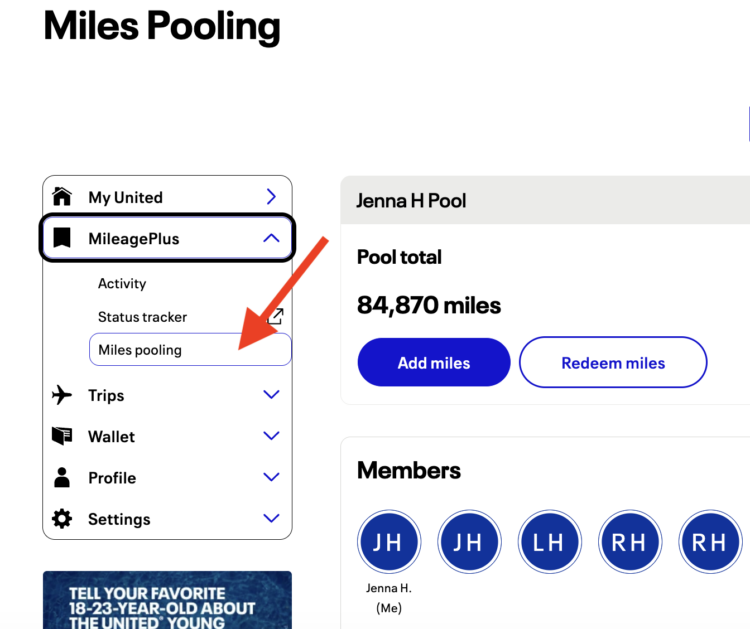
Another helpful benefit of family pooling is combining smaller balances to book an award ticket. For example, if someone's mile balance is too low, having a family pool can help them reach the number of miles needed.
Earlier, when I first created our United family pool, my kids each had 5,000 miles — not enough to book an award flight. But combined, those miles added up to enough for at least one ticket, if not two.
United miles do not expire as long as the account is open. However, depending on the program's rules, pooling can help you use your points and miles before they expire.

Related: What Is a ‘Player 2' in Points and Miles?
Make Sure Your Kids Are Earning Miles
Most major airlines allow children to open an airline loyalty account. Depending on the airline, they may need their own email address or parental consent. You can then use that email to open a loyalty account with their personal details. Be sure to save the login information that you set up.
When you book flights, add their loyalty number to the booking so they get credit for the flight. But remember that only cash flights will earn miles; award flights won't.
Things To Consider Before Pooling Miles
As good as family pooling can be, there are times when it may not be the best option:
- Trust issues: Some family pooling programs, like Frontier Airlines, allow you to define your family however you want, meaning you can create a pool with friends. In this case, make sure you trust the pool head, who is responsible for redeeming miles.
- Which airlines you actually use miles with: It may not be worth it to establish a family pool with an airline that you don't often fly.
- Who can redeem miles: Most programs have a pool leader, and some limit redemptions to this person. If you pool miles, make sure you won't lose access to them when you need them. On the plus side, if the leader has elite status and is traveling, others on the same reservation may benefit from certain perks, depending on the airline.
- How often you'll use the pool: Using a pool also might not make sense if you rarely redeem points and miles for other people. There's no use creating a pool if you're not likely to use it to share your miles.
- Restrictions on leaving: Some programs require you to stay in a pool for a certain period or wait before joining another. Make sure you understand these restrictions before combining your miles.
What Happens When a Child Turns 18?
When your child turns 18, their loyalty account will still be linked to their email. However, programs vary in terms of what happens to the account and the miles accrued. Here are a few noteworthy things to know.
What happens to the account?
- Programs with no age rules: Programs like United, JetBlue, Air Canada, and Frontier don't automatically remove members from a pool when they turn 18, so nothing about the account changes just because they become an adult.
- Programs that cap adults: Flying Blue limits family pools to two adults. If a child turns 18 and there are already two adults in the pool, they'll automatically be removed. Avianca LifeMiles also automatically deactivates members when they turn 18, regardless of how many adults are in the group.
If a child turns 18 and stays in the pool, their miles don't change. However, if they leave the pool or are removed, what happens to their miles depends on the program. Here's an overview:
Programs where miles stay in the pool
- United: If they leave the pool, any miles contributed stay with the pool.
- Virgin Atlantic: Miles earned while in a household account stay with the household leader. However, when they leave the account, they keep any miles earned before joining that weren't transferred to the household account.
- Qatar: Members of the Family & Friends program earn miles directly into the primary member's account, so there are no miles to take if you leave.
- Emirates: Like Virgin Atlantic, miles earned while part of a family account stay with the account, but miles earned before joining remain in the member's individual account.
Programs where miles stay with the member
- JetBlue: Their remaining unused miles go back to their account.
- Air Canada: Members leave the pool with their remaining individual points balance, accounting for any redemptions made while they were in the pool.
- British Airways: Children under 18 can only earn Avios through a household account. Once 18, a pool member can leave and keep the Avios they earned.
- Flying Blue: Miles stay in a pool member's account until the leader moves them. If they aren't moved, the member can leave and keep their miles. However, if the leader has already moved the miles, they remain with the leader.
What To Do if a Program Doesn't Allow Pooling
If an airline doesn't allow pooling, you still have a few options. First, most airlines allow you to book a ticket for someone else. So if you have miles available and want to share them with someone, you can just book their ticket through your account. No sharing of miles necessary.
Another option is to transfer points between bank accounts first. For example, both Chase and
Chase limits sharing to eligible household members (or business owners, where applicable), while Capital One lets you share miles with anyone who has an eligible miles-earning card.
If you're planning to transfer those bank points and book a flight with an airline that doesn't offer pooling, you could combine your points before transferring them to the airline.
Bottom Line
Pooling points and miles can be an amazing tool for families. Many airlines and hotel programs allow it (often for free), and pools in most programs are easy to set up and use. While pooling isn't for everyone, it can be a great way to unlock your next award redemption faster by working as a team.
Page Contents
- How Points and Miles Pooling Works
- Programs That Allow Families To Pool Points and Miles
- Do Hotels Allow Family Pooling?
- Why Pooling With Your Family Makes Sense
- Make Sure Your Kids Are Earning Miles
- Things To Consider Before Pooling Miles
- What Happens When a Child Turns 18?
- What To Do if a Program Doesn't Allow Pooling
- Bottom Line