





AwardWallet receives compensation from advertising partners for links on the blog. The opinions expressed here are our own and have not been reviewed, provided, or approved by any bank advertiser. Here's our complete list of Advertisers.
Many in the points and miles space operate under an earn-and-burn philosophy, driven by the idea that the longer you sit on unused
I don't subscribe to the earn-and-burn philosophy because I value access to those points when I need them, not their literal per-point value. I also don't generally obsess over past or future devaluations. But is there any way to protect our hard-earned rewards?
Enter MileProtection's points and miles devaluation insurance.
How Does MileProtection Points and Miles Devaluation Protection Work?
MileProtection offers two contract types. The first safeguards the value (cents per point) of your rewards against program devaluations. The other protects against the loss of partners within transferable programs, compensating you if a program fully drops a transfer partner.
MileProtection is currently invite-only, and anyone interested in these services needs to join a wait list. It's also worth noting that this isn't legally considered insurance, but rather a parametric, innominate service contract (basically, a legal agreement where compensation is directly tied to measurable data points). As such, you don't need to file a claim form or show any tangible loss. Payouts trigger automatically when the contracted criteria are met.
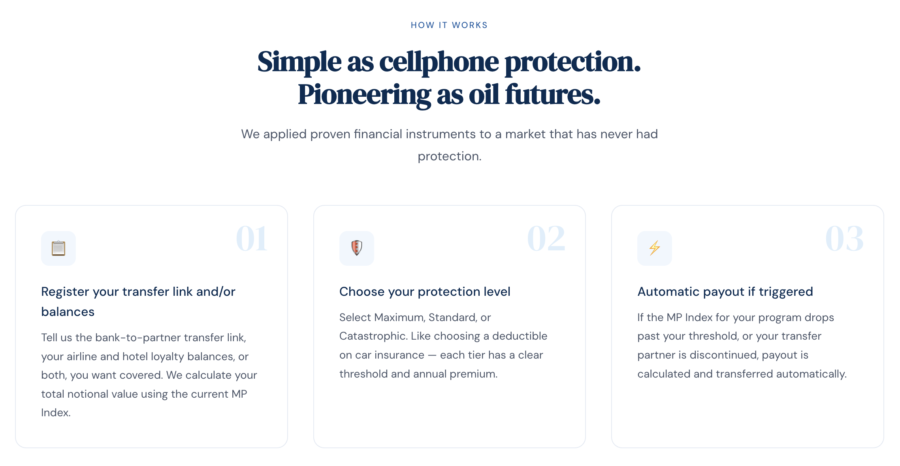
How MileProtection Works
With MileProtection, you're not insuring a specific trip; you're protecting against loss of value for a specific program. MileProtection keeps a valuation index table for the programs it covers and uses those data points to trigger a payout if the thresholds you have contracted are met.
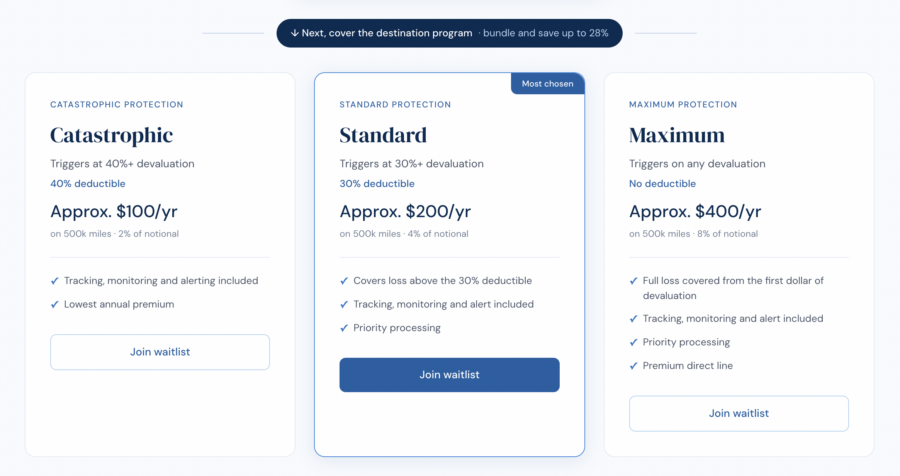
MileProtection offers three tiers of protection:
- Catastrophic: A 40% deductible and costs about 2% of the MileProtection value of your points and miles each year.
- Standard: A 30% deductible and costs about 4% of the protected value per year.
- Maximum: No deductible. You are covered against any devaluation, and it costs around 8% of the covered value of your points every year.
For example, let's use my favorite hotel
How is my payout calculated? If, heaven forbid, Hyatt devalues, MileProtection will apply the following equation to calculate your compensation:
(Devaluation percentage – deductible percentage) * protected notional value.
In other words, if I choose the standard plan, I'll spend around $204 per year for coverage. If the program drops 40% in value and I have a 30% deductible, my payout will be 10% of the value MileProtection assigned to my 300,000 Hyatt points, or $510.
How is MileProtection value calculated?
MileProtection doesn't publish its full valuation methodology, so it's virtually impossible to know exactly how it calculates value. However, the values listed on its website come in consistently lower than AwardWallet's points and miles valuations.
However, as per MileProtection's website:
“We track actual redemption value across a basket of 20 representative routes — not what airlines say, but what your miles can actually buy. When that drops past your deductible threshold, your protection triggers.
The full methodology will be published once the product is live. In a nutshell: we look mostly at business class redemptions, sampled at fixed points in time so both low and high season are covered (e.g. Christmas, September, summer holidays) — routes like New York–Paris, Los Angeles–London, and the reverse direction too. Valuation is based on cash-and-miles bookings, not partner-airline award redemptions. The cash component includes fees, taxes, and fuel surcharges, for example.
This creates uncertainty in how values and devaluation thresholds are calculated, which can result in payouts not triggering because calculations may differ from those outside MileProtection's index.
Which programs are covered?
The MP Index is updated weekly. At the time of writing, it covers the following airline programs:
United MileagePlus Delta SkyMiles American Airlines AAdvantage - Air Canada Aeroplan
- Avianca LifeMiles
- Avios-earning programs (British Airways, Iberia, etc.)
- Air France/KLM Flying Blue
- Singapore Airlines KrisFlyer
- Cathay Asia Miles
- Miles&More programs (Lufthansa, SWISS, etc.)
- Turkish Airlines Miles&Smiles
- ANA Mileage Club
- JAL Mileage Bank
And the following hotel programs:
Transfer Partner Protection
By comparison, Transfer Partner Protection is much simpler than MileProtection. You are covered if your bank issuer drops a specific transfer partner fully and permanently from its program. Transfer Partner Protection only covers U.S.-based programs including
This doesn't protect you if any program drops any transfer partner. You choose a specific transfer partner within a program (or multiple transfer partners) that you want to protect. Each transfer partner you'd like covered will cost $50 annually, with a discount the more partners you include. That way, if the partnership ends, you will receive a payout as a bank transfer or a travel voucher you can redeem with MileProtection.
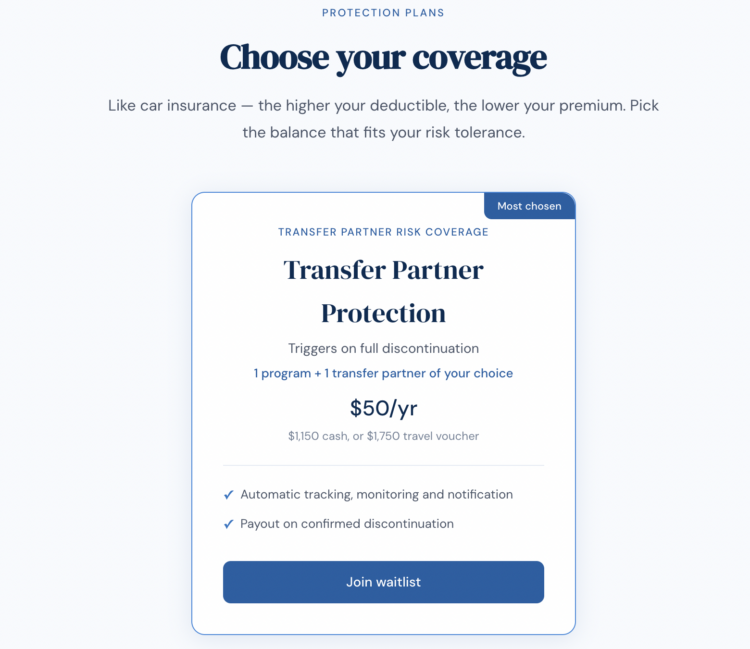
Transfer Partner Protection is much more straightforward than MileProtection. If you cover a transfer partner and it gets removed, you get a payout. However, you'll want to pick and choose which partners are covered.
For instance, Bilt offers 24 transfer partners. If you were to cover each one, you'd spend $1,200 each year. That's probably not worthwhile. However, you might want to protect Etihad.
Should You Buy Devaluation Insurance?
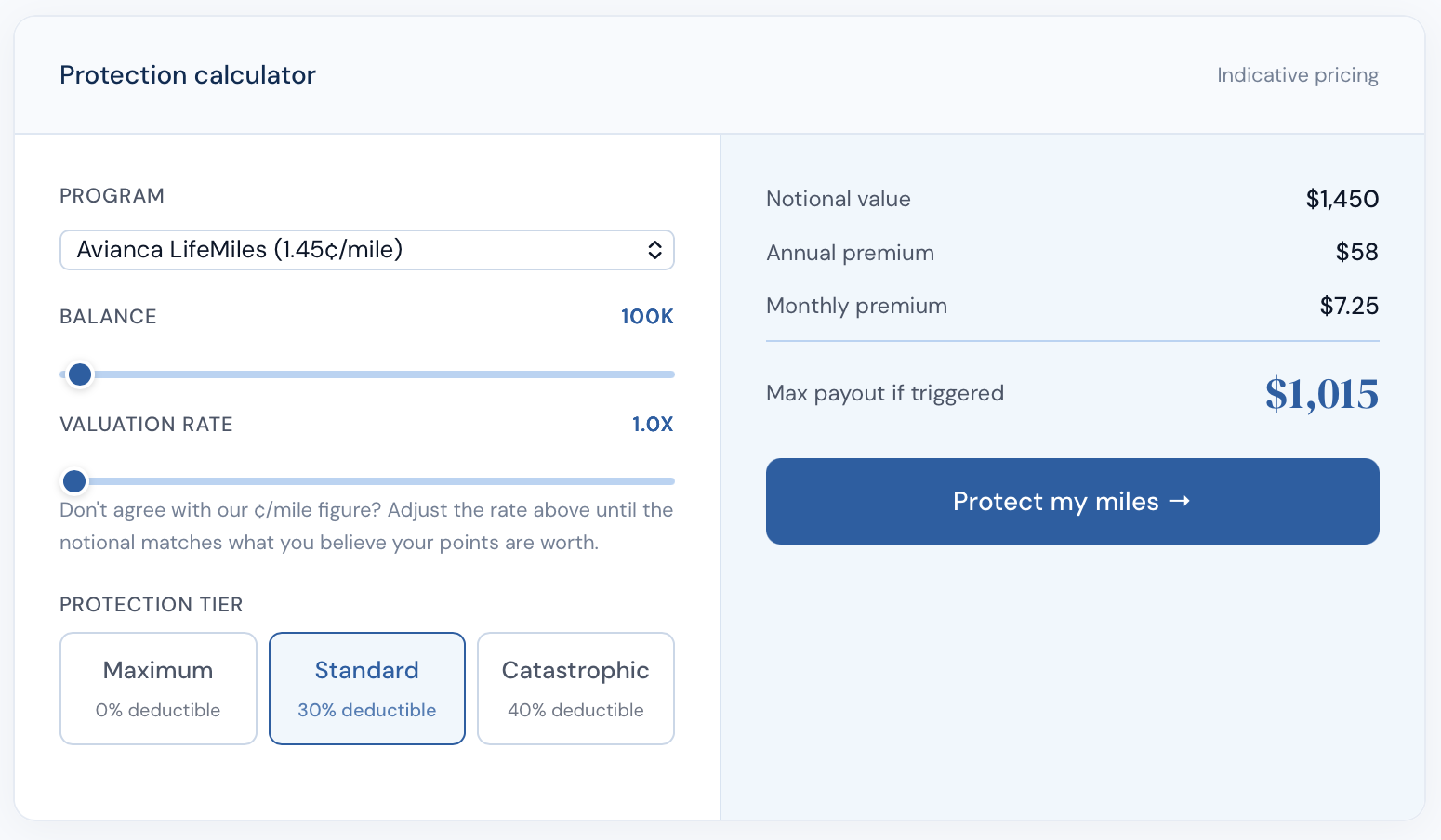
Let's do a little math. Out of the Avianca LifeMiles accounts linked to AwardWallet, users have an average balance of 118,800 LifeMiles. At the time of writing, MileProtection values LifeMiles at 1.45¢ apiece.
If you wanted to protect 100,000 of your LifeMiles — worth $1,450 at MileProtection's current valuation — you'd spend:
- $29 per year on a Catastrophic plan
- $58 per year on a Standard plan
- $116 per year on a Maximum plan
If your LifeMiles are devalued by 50%, here's how much you'd receive, depending on your plan:
- $145 payout on a Catastrophic plan
- $290 payout on a Standard plan
- $725 payout on a Maximum plan
The maximum payout shown in the screenshot below applies if your miles lose all value, which is extremely unlikely. Your actual payout should be much less.
Similarly, out of almost 30,000 active Marriott Bonvoy accounts linked to AwardWallet, users have an average balance of 163,300 points.
If you wanted to protect 150,000 of your Marriott Bonvoy points, worth $1,065 based on MileProtection's 0.71¢ valuation, you'd spend:
- $21 per year on a Catastrophic plan
- $43 per year on a Standard plan
- $85 per year on a Maximum plan
If your Marriott Bonvoy points are devalued by 50%, here's how much you'd receive, depending on your plan:
- $106.50 payout on a Catastrophic plan
- $213 payout on a Standard plan
- $532.50 payout on a Maximum plan
As you can see, if you don't have millions of points to protect, you won't spend a ton of money on MileProtection, so the payout could be worth it. Even if you do have millions of points, the premium might be less than you expect.
For instance, if you have 2 million Delta SkyMiles in your account because you travel for work and you have a co-branded SkyMiles credit card, you'd pay $1,680 per year for a Maximum protection plan. If Delta SkyMiles were devalued by 30% overnight and you were on the maximum plan, you'd get a $6,300 payout.
The higher your point balances, the more MileProtection makes sense. Although the fee isn't necessarily small, the devaluation payout gets much larger. If we've learned anything, it's that programs will likely devalue over time, so there's a good chance you can recoup your premium.
Bottom Line
The idea of points and miles devaluation insurance sounds intriguing, but I have to admit it seems quite pricey given the relatively high balances I have in most programs I use. To me, the best I can do for points and miles devaluation insurance is make sure I generate enough rewards to grow my proverbial piggy bank consistently, and that I always have enough to redeem for the awards I want — regardless of any program devaluation.
Will you consider points and miles devaluation insurance to protect you against the inevitable changes programs will implement in the future? Let us know in the comments!