



AwardWallet receives compensation from advertising partners for links on the blog. The opinions expressed here are our own and have not been reviewed, provided, or approved by any bank advertiser. Here's our complete list of Advertisers.
Since the 2020 relaunch of the Aeroplan mileage program, Air Canada has offered a unique zone-plus-distance award chart. Although this award chart has been tweaked over the years, Aeroplan’s generous policy on stopovers still remains a part of the program. Travelers can add a stopover for just 5,000 extra Aeroplan points, letting travelers build highly customized itineraries as part of the same award. By using the nuance of the award chart to your advantage, there are ways to save points along the way.
While a seemingly unlimited number of options exist, this post outlines just a few examples below of how to make the most of Aeroplan stopovers and open-jaw awards.
Page Contents
Aeroplan Stopover Award Basics
Before jumping straight into itinerary examples, it is important to highlight a number of key items regarding rules for Aeroplan stopovers:
- Aeroplan awards are priced by each one-way journey.
- Stopovers are only permitted for Aeroplan award travel outside Canada and the United States.
- Stopovers are distinct from layovers — which can generally last up to 24 hours without needing to pay for a stopover. See our layover vs. stopover explainer.
- Aeroplan charges 5,000 points for each stopover.
- Stopovers cannot exceed 45 days.
- Aeroplan offers one stopover per one-way or two per round-trip booking.
The fact that adding a stopover to a trip costs just 5,000 points, regardless of trip length, represents incredible value on its own. Actually, sometimes adding a stopover can even be fewer points!
Travelers can book Aeroplan stopover awards over the phone or via aircanada.com.
Examples of Aeroplan Stopover Awards
Saunter through South America
The first secret stopover sweet spot worth highlighting stays entirely in South America. The latest version of Aeroplan’s award chart prices travel within this zone into two categories based on distance:
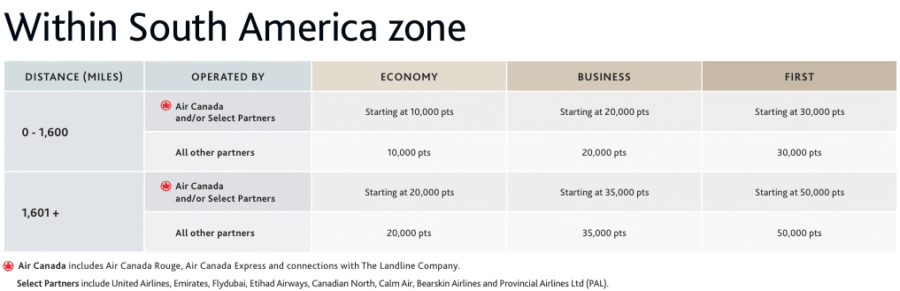
Note the distinction on the chart between “Air Canada and select partners” versus “All other partners.” Air Canada went to dynamic pricing earlier this year for select partners. Thankfully, you don't have to worry about this quirk for flights within South America.
Aeroplan only has two distance bands for flights within South America. Itineraries spanning more than 1,600 miles in South America already cost the most they possibly can. Adding a 5,000-point stopover to such a trip pushes total mileage costs to 25,000 in economy class and 40,000 points in business class.
The Galápagos Islands in Ecuador are a wildlife lover’s dream destination. But South America offers much more than the diverse species of the Galápagos. Utilizing the rules for Aeroplan stopovers, travelers could fly between the Galápagos (GPS) and Buenos Aires (EZE), stopping in Sao Paolo, Brazil (GRU) along the way to experience a third country.
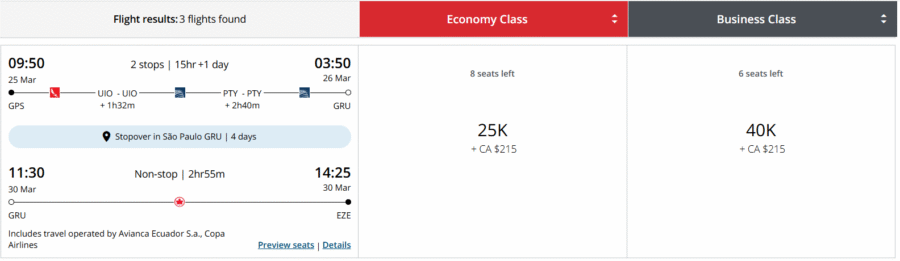
This journey spans over 5,500 miles in total. Cash costs for one-way travel between these two locations can be $700 or more, and adding a stopover would only increase the cost. Spending 25,000 Aeroplan points instead (and factoring in the taxes and fees on the award ticket) leads to a redemption rate of around 2.0 cents per point! That's better than the 1.28¢ per Aeroplan point AwardWallet users average in value from long-haul economy Aeroplan awards.
Additionally, we ran into a quirk you should know about when researching examples for South America. Copa Airlines is based in Panama, which is technically in the North America region. However, it flies to numerous places in South America. Multiple itineraries offered flights from one South American country to another using Copa Airlines. Like the above example, this flight left the South American region but then returned to this region in the end. Pricing followed what we expect for “within South America” awards.
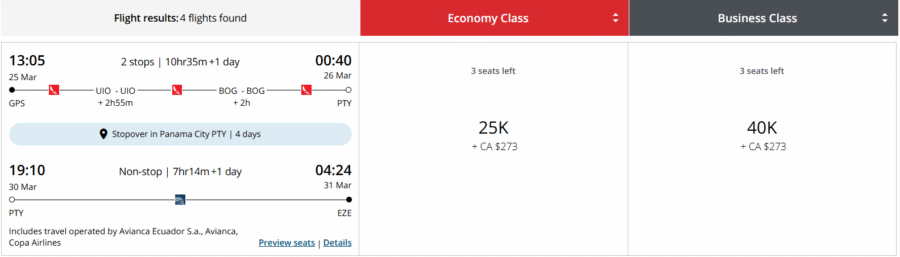
In fact, you can even add a stopover in Panama City (PTY) instead of São Paulo, and the award will still be priced in accordance with the “within South America” award chart. This points to a potential flexibility among routing rules within the Aeroplan program.
Adventure across the Atlantic
A second secret stopover sweet spot of Aeroplan's updated award chart spans three continents instead of just one. Under the new region definitions, the entirety of Europe and Africa falls under the “Atlantic” zone.
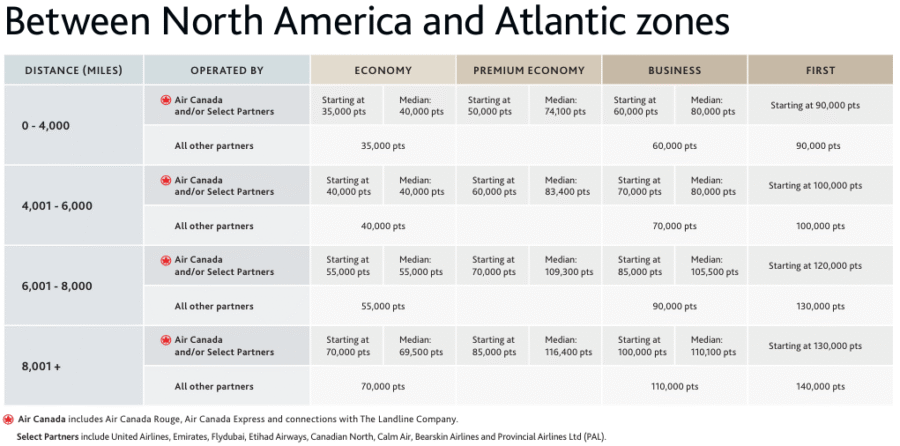
That means that travelers starting in North America will use the same Aeroplan award chart whether their final destination is in Europe or in Africa. And, thanks to an award chart quirk, visiting two locations across the Atlantic with a stopover can wind up cheaper than booking each flight separately.
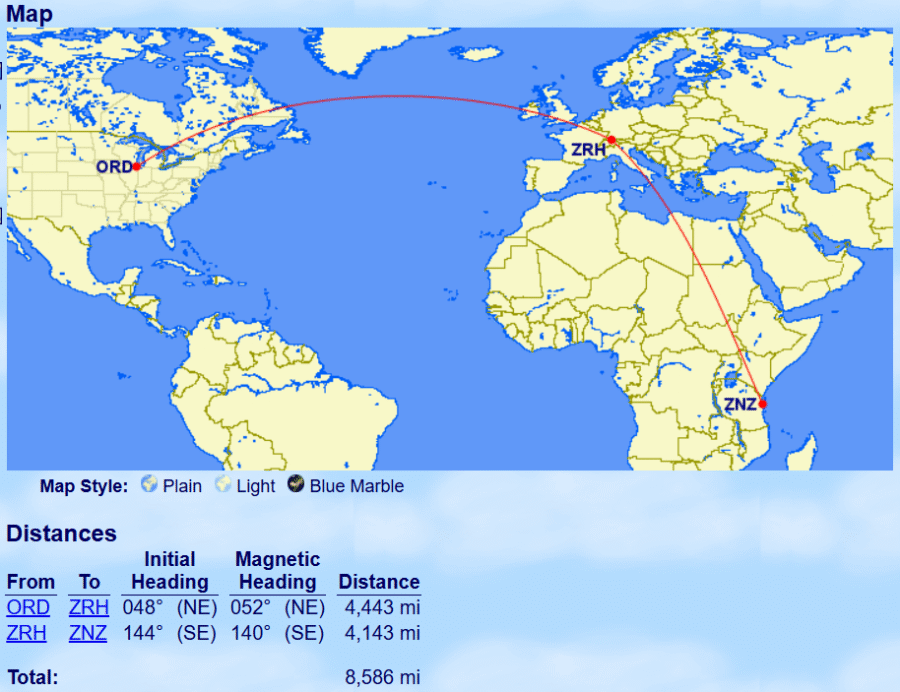
For instance, let's examine an itinerary taking travelers from Chicago (ORD) to Zanzibar (ZNZ) via Zurich (ZRH). This trip would give you a lengthy stay in Switzerland to enjoy the beauty of the Alps before heading to Zanzibar for some safari time. This journey spans 8,586 miles: 4,443 miles from Chicago to Zurich and another 4,143 from Zurich to Zanzibar.
According to the chart above — assuming no select partners are flown — Aeroplan prices this kind of trip at 70,000 points in economy class or 110,000 points in business class. The business class price is especially reasonable for almost 20 hours of flight time.
Turning this layover into a stopover would add 5,000 miles regardless of class of cabin — making the total points requirement 75,000 for economy or 115,000 for business.
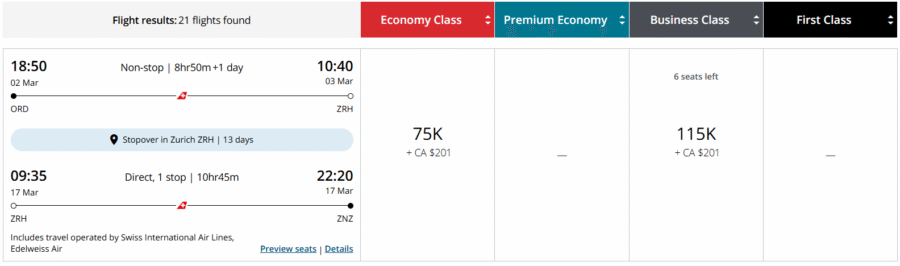
Meanwhile, booking the two flight segments separately increases the total points cost of the trip.

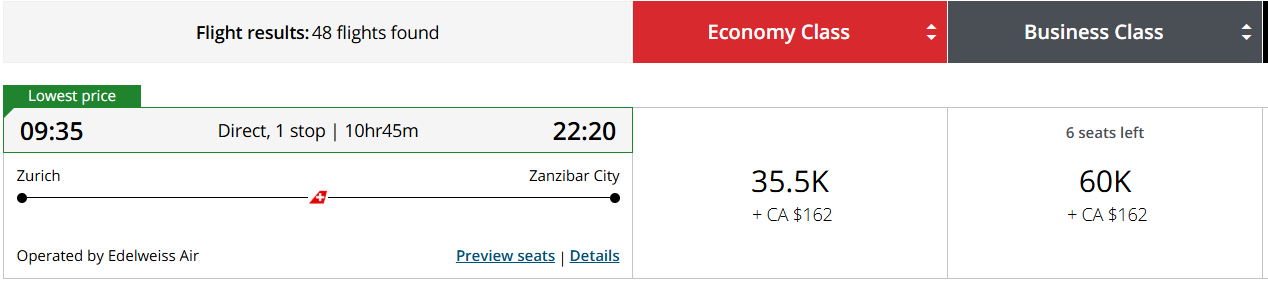
By booking separately, instead of booking together with a stopover, the total trip cost would be 75,500 points in economy class or 130,000 points in business class. In this case, the economy difference is negligible but the business class itinerary saves 15,000 points when booked as a stopover. The fees are also slightly cheaper.
Fly more to spend less
Aeroplan notoriously allows for flexible (and sometimes illogical) award trip routings. Particularly, when flying from North America to Southeast Asia, eastbound or westbound travel is permitted. Savvy travelers can take advantage of this program quirk on long trips between these regions.
For instance, take a sample journey from San Francisco (SFO) to Bangalore, India (BLR). This trip between the North America and Atlantic regions (yes, the Atlantic region includes the Indian Subcontinent) with a connection in Delhi clocks in at just under 9,000 miles of flying. Award costs on this route are 70,000 points in economy and 110,000 points in business for one-way travel.

Now for the fun part: Instead of ending the journey in Bangalore, adding an extra segment to the trip and making time spent in Bangalore simply a stopover could actually decrease the overall trip cost. Thai Airways offers service between Bangalore and Bangkok on an A350 with nice, lie-flat seats in business class.
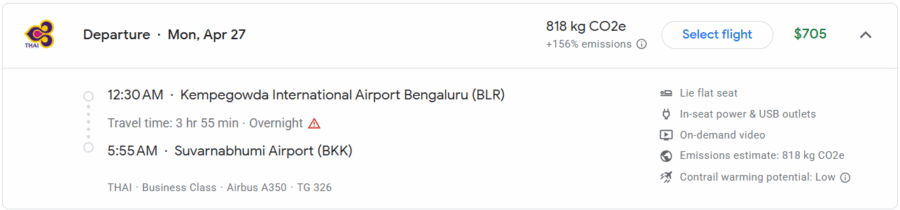
Such a segment spans 1,550 miles, making the total trip distance just under 10,500 miles. Bangkok belongs to the Pacific region, where a one-way journey from North America between 7,501-11,000 miles costs just 60,000 points in economy or 87,500 in business. The stopover in Bangalore adds another 5,000 points to these amounts.
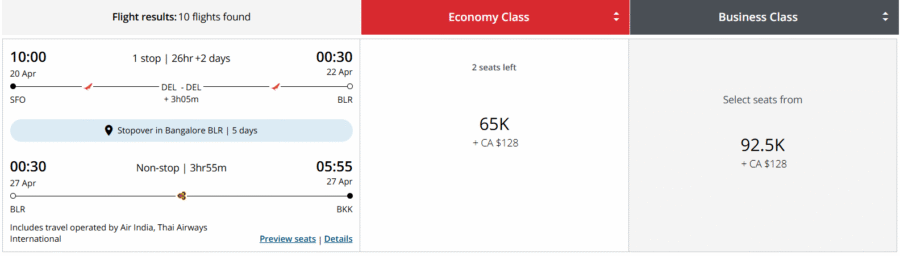
When you compare this to the simple award itinerary to Bangalore, you see the net points cost decreases as a result of adding the Bangalore to Bangkok segment — even after adding the 5,000-point cost for the stopover. By using the rules for stopovers, economy class travelers save 5,000 points in this scenario. Business class travelers save 17,500 — plus the $705 cost of a business class ticket to Bangkok. Visiting a second destination is just another bonus to this itinerary!
How to Book an Air Canada Aeroplan Stopover
Booking a stopover with Aeroplan can be done easily online. Begin by logging into your Aeroplan account and navigating to the flight search page. Check “Book with Aeroplan points” and select “Multi-city” from the dropdown menu.
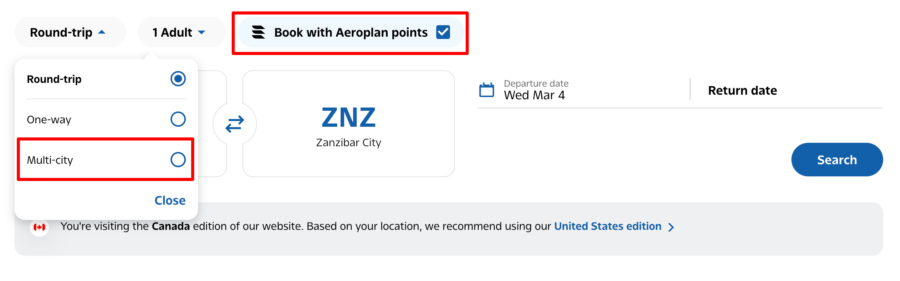
You'll see an option to add a stopover on either your departure or return flight. You can select how long you'd like to spend in your stopover destination, anywhere from one to 45 days.
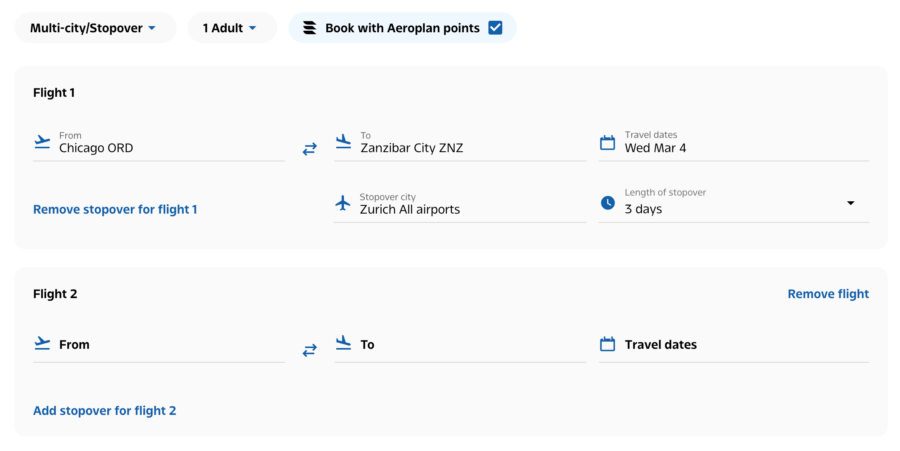
If you want to book a one-way award, select the option to “remove flight” to remove the return flight.
Maximizing Aeroplan Open-Jaw Awards
Open-jaw awards are nothing new to Aeroplan. For those unfamiliar, an open jaw is when a round-trip itinerary flies to one destination on the outbound but returns from a separate city. Think of flying from your home airport to London and then flying back home from Paris.
What has changed is the way in which open jaws can be utilized within the Aeroplan program. This is due to Aeroplan’s adoption of distance-based award costs in conjunction with award regions. Again, there will be countless examples of how travelers can take advantage of open-jaw awards. I think the example below paints a clear picture of how this open-jaw sweet spot works.
Imagine a trip beginning in Seattle with planned stops in Taipei, Tokyo, and Seoul. All three cities enjoy direct service to/from Seattle, although not all direct flights are equal. The order of these cities ends up mattering, as well as the way in which things are booked.
Let’s start with an outbound journey from Seattle to Seoul with a stopover in Tokyo, coupled with a return journey from Seoul to Seattle with a stopover in Taipei.
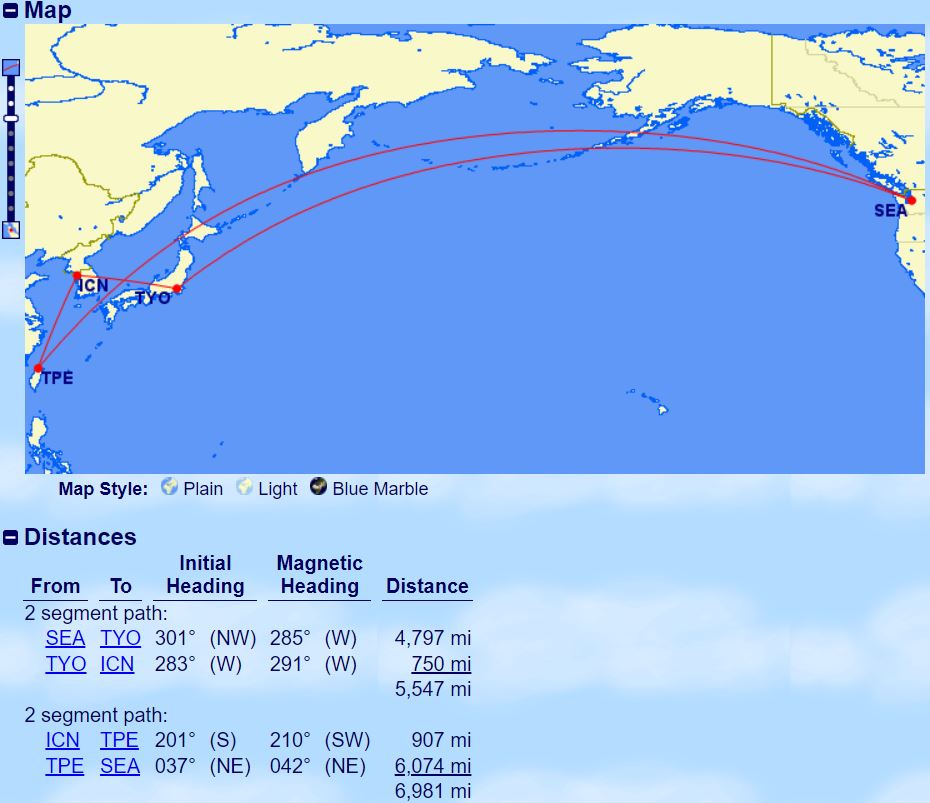
Booked without an open-jaw
This itinerary does not utilize any open jaw, and as a result the total trip points cost would be as follows:
- Seattle – Tokyo – Seoul
- 50,000 points for economy class
- 75,000 points for business class
- Add 5,000 points for the stopover in Tokyo
- Seoul – Taipei – Seattle
- 50,000 points for economy class
- 75,000 points for business class
- Add 5,000 points for the stopover in Taipei
- Overall trip cost: 110,000 in economy or 160,000 in business
Now, let’s look at the exact same trip but with an open jaw between Tokyo and Seoul.
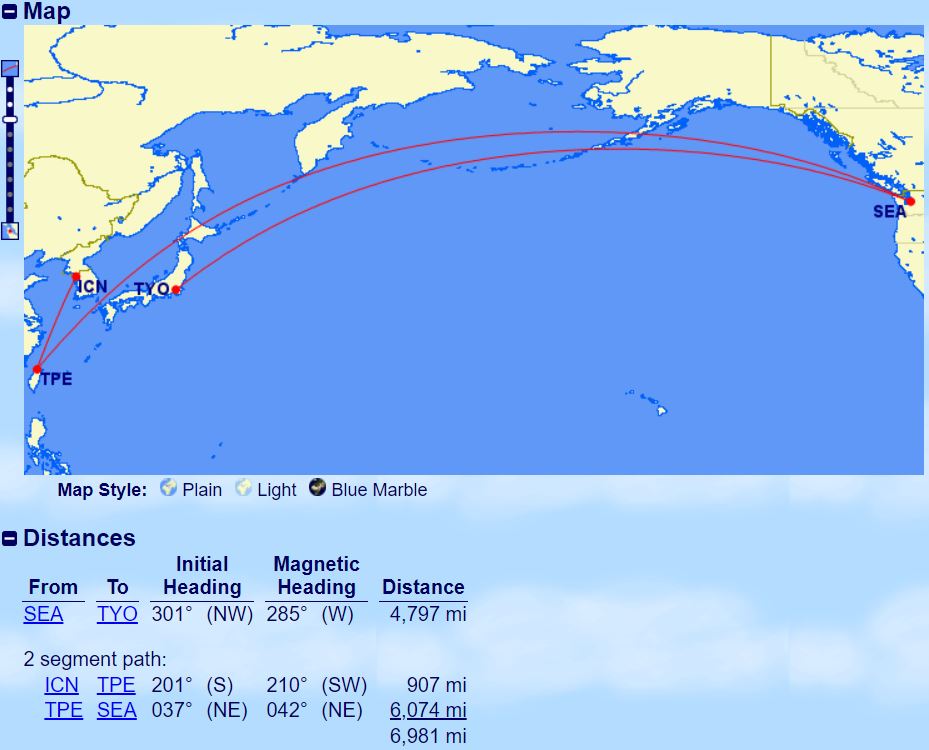
Booked with an open-jaw
This itinerary does make use of an open jaw. In doing so, it saves on points:
- Seattle – Tokyo
- 35,000 points for economy class
- 55,000 points for business class
- Seoul – Taipei – Seattle
- 50,000 points for economy class
- 75,000 points for business class
- Extra 5,000 points for the stopover in Taipei
- Overall trip cost: 90,000 in economy (-20,000 points) or 135,000 in business (-25,000 points)
In total, skipping the 750-mile flight between Tokyo and Seoul saves travelers anywhere from 20,000 to 25,000 Aeroplan points, depending on the class of service. Getting between Tokyo and Seoul separately is quite easy. Travelers can utilize relatively inexpensive cash fares to get between the two or a litany of points and miles options.

Best Ways to Earn Aeroplan Points
Aeroplan points can be earned and redeemed on nearly 50 Aeroplan airline partners — including any Star Alliance airline (as Air Canada is a Star Alliance member) as well as a large number of non-alliance Aeroplan partners. Fortunately, many options exist for transferring points to Aeroplan, as well.
U.S. travelers can also earn Aeroplan points directly through the Aeroplan® Credit Card (Rates & Fees).
The $95 annual fee for this Aeroplan Card pays for itself for anyone who regularly flies Air Canada and checks a bag. Cardholders and up to eight companions on the same reservation may check one bag for free when travel originates on Air Canada.
Interestingly enough, even scarce travelers may be interested in this card thanks to its inclusion in the Chase Pay Yourself Back program. The redemption rate of 1.25 cents per point on travel expenses might be less than what travelers expect to see when redeeming points for flights. However, this feature effectively creates a “floor” redemption value and creates flexibility to extract value from the points they earn.

- Earn 60,000 bonus points
- Earn 60,000 bonus points after you spend $3,000 on purchases in the first 3 months your account is open.
- $95 Annual Fee
- Redeem points for both international and domestic flights with the Aeroplan® Credit Card.
- Fly to another continent and travel the world with the Aeroplan® Credit Card.
- Earn 3X points for each dollar spent at grocery stores, on dining at restaurants, and Air Canada directly. Earn 1X point for each dollar spent on all other purchases.
- 500 bonus points for every $2,000 you spend in a calendar month - up to 1,500 points per month.
- Member FDIC
- 3x points directly with Air Canada
- 3x points on dining, including takeout and eligible delivery services
- 3x points at grocery stores
- 1x point on all other purchases
Since Air Canada is based in Canada, the Aeroplan program also offers fantastic co-branded cards for Canadian flyers:
- American Express® AeroplanPlus®* Platinum Card
- American Express AeroplanPlus Corporate Platinum Card
- TD® Aeroplan® Visa Infinite
- TD® Aeroplan® Visa Platinum
- TD® Aeroplan® Visa Business
Bottom Line
Aeroplan's generous policy on stopovers is a great feature of the program. That policy can be very award-traveler-friendly. Just 5,000 points per stopover allows Aeroplan members to see more destinations for less.
Additionally, strategic open jaws offer travelers another opportunity to save points when traveling. While this article provides just a flavor of the possibilities with stopovers and open jaws, it provides all the ideas necessary to cook up a personalized trip with Aeroplan. Remember, tools such as gcmap.com are incredible resources for calculating total trip distances.
For rates and fees of the cards mentioned in this post, please visit the following links: Aeroplan® Credit Card (Rates & Fees)